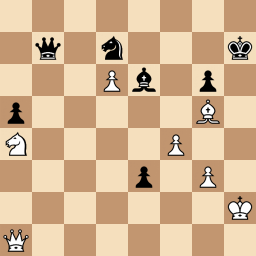
Theme: Middlegame study. In the starting position each side must have queen and a minimum of 2 other pieces (rook, bishop or knight), also at least 1 pawn. The white king must be positioned on a1, a2, b1, b2, c1, c2, f1, f2, g1, g2, h1 or h2. Likewise the black king must be positioned on a8, a7, b8, b7, c8, c7, f8, f7, g8, g7, h8 or h7.
Judge Steffen Nielsen: “To me the middlegame study will be a major battleground of future studies, as new ideas with few pieces are becoming increasingly difficult to develop (but not impossible). I realize the theme I chose for this version of the YCCC is also very difficult, since creating interesting, unique winning lines with 10 or 15 pieces is much more difficult than doing the same in simpler positions. Especially if you want to make every piece to take part in the action. On the other hand, in middlegame studies the sky is very much the limit and with good and ambitious ideas it is possible to create real art with a substantial appeal to regular chess players who love to solve positions who resemble a real game but still reveals something unique. I received 11 studies in anonymous form”.
A possible correction of 5° place. Two more pawns to avoid Bh4 with capture and to have a clearer draw after 7. Kb1?
Also 1. … Qc6 returns as refutation and as sideline.
Garcia corrects better.
Also Pervakov does.
Daniele, before correcting anything you had to understand:
Thanks for explainations. To be honest I was trying to eliminate the black knight because of its passive role, but mantained it to keep the study on the theme of the tourney.
Your version below is surely more economic and focused.
A true middlegame version of the 5th place.
Luchshe naverno tak:
I don’t recommend adding the 4th white piece for the sake of its sacrifice. It’s better to keep 3×3 major pieces balance.
Steffen writes “To me the middlegame study will be a major battleground of future studies, as new ideas with few pieces are becoming increasingly difficult to develop (but not impossible).”
I am not sure whether this is really true. I think the production of miniatures and super-miniatures in the last years, for example, has been of excellent quality, producing not only technically strong, but also original studies. Some examples follow. Of course I am biased toward my own work and Martin’s because I like it and remember it well, but I am sure there are lots of great miniatures I forgot to include.
https://eg.org.ua/chessgame/horneckers-minskim-nn-0401-11b4c7-mc/
https://eg.org.ua/chessgame/sprengerj-3131-10h4b7/
https://eg.org.ua/chessgame/tarasiukv-0313-20a6h6/
https://eg.org.ua/chessgame/nielsens-minskim-0404-10a2h4/
https://eg.org.ua/chessgame/minskim-nielsens-0040-11b8a5/
https://eg.org.ua/chessgame/sprengerj-0034-11e3h8/
https://eg.org.ua/chessgame/didukhs-0013-21b8h1/
(also my pawn endgame from EG 2021 could be listed, it is in my WCCI submissions)
These are from the last 3-4 years only. Has there really been a period where composers have been more successful at composing exciting miniatures? For substantiating a claim like “increasingly difficult”, one should sample at random from miniatures of, say, 20, 50 or 80 years ago and do a systematic quality comparison. My guess is that the modern studies will not do worse.
Of course, the motives in miniatures are limited, but for combining them in a fascinating way, there are still lots of possibilities.
One problem I see with proper middlegame studies is that they often look like tactical calculation tasks. Of course, there are some wonderful examples, like Steffen’s study from SCHACH, 2019, but to me, a full board takes away a lot of the charm of studies. The highest artistic quality themes may be in the middle, like in this recent work of Oleg, which I like a lot:
https://www.problemistasajedrez.com.ar/21th-international-internet-tournament-uapa-2023/pervakov-y-cia-sec-b-1-stagram/
My point of view is similar.
I feel that one great miniature happens at the same rate as 10-15 middle great studies and 2-3 big ones. And I don’t think this trend will change in the next 100 years. That’s why Steffen’s call to prepare young composers for future middlegame battleground was at least too premature. It’s true that the number of big studies has increased recently but the level of these monsters is scary.
Ok, but I didn’t write “the” major battleground. Just “a”.
I must first make an important distinction: Not all studies with many pieces are middlegame studies.
Take a look at Ural Khasanov’s study. 14 pieces and clearly a middle game. Then take a look at Timman’s for Garcia 75. 20 pieces, but not a middlegame study in my view, because of the unnatural position. The term “middlegame study” is primarily defined by its resemblance to OTB positions and not by the number of pieces.
One characteristic of middlegame studies is the presence of pawns protecting the king. I made an example of this for Twitter, which miraculously has made its way to Serhiy’s database. It has “only” 12 pieces, but has a clear middlegame feel:
https://eg.org.ua/chessgame/nielsens-4440-22g1g8/
(It was inspired by the game sequence 1. Qf6! Qc1!! in Kunneman – NN, 1936 as explained here
https://twitter.com/SteffenNielsen8/status/1654105024283258887
)
Another characteristic of a middlegame study is that both kings must be placed near their own back rank.
Like in this one (which in other aspects is a little too unnatural for my liking)
https://eg.org.ua/chessgame/nielsens-4413-26c2g8/
It is also important that the starting position looks like something that could have happened in a game. Structures known from specific openings (like Black pawns on f7-g6-h7) are also a plus.
This naturalness is probably more important to me than to other composers. As Martin often tells me, we are in the art business and the starting positions can well be artificial. He has no problem with a starting position with Black pawns on e7 and g7 and the f8-bishop gone from the board, while I would very much like to avoid it.
It is probably no secret that I have a special fondness for 3 vs 3 pieces. The two best studies in the 7th YCCC are with that material as well.
My breakthrough study for Timman 60 JT features that material distribution and so do some of my best WCCI- studies. None of them were really middlegame studies, though.
Looking back at some of my early studies, which I very much liked back then, I now frown when seeing that they feature 3 vs 4 pieces or even 3 vs 2 when 3 vs 3 could easily have been arranged. That distribution really has special meaning to me. 90 percent of the stuff I work on presently seem to end up with 3 vs 3. Like Serhiy writes, 3 vs 3 pieces provide endless possibilities for showing new complicated tactics.
Some middlegame studies:
https://eg.org.ua/chessgame/minskim-pervakovo-4440-36g1f7/
https://eg.org.ua/chessgame/didukhs-4750-46h2h7/
https://eg.org.ua/chessgame/nielsens-4040-33g3h6/
https://eg.org.ua/chessgame/nielsens-4440-33h2h8/
https://eg.org.ua/chessgame/slumstrup-nielsens-4404-46h3g8/
https://eg.org.ua/chessgame/slumstrup-nielsens-minskim-4533-54h1h8/
https://eg.org.ua/chessgame/slumstrup-nielsens-minskim-4453-52h1h7/
Studies with many pieces which I don’t consider middlegame studies:
https://eg.org.ua/chessgame/slumstrup-nielsens-4440-13e3h6/
https://eg.org.ua/chessgame/slumstrup-nielsens-4321-26e6d4/
https://eg.org.ua/chessgame/nielsens-3234-12e8g7/
https://eg.org.ua/chessgame/slumstrup-nielsens-0440-23f6c3/
https://eg.org.ua/chessgame/nielsens-4017-35h4h6/
https://eg.org.ua/chessgame/nielsens-0444-44a4c1/
https://eg.org.ua/chessgame/slumstrup-nielsens-minskim-0363-82e1e5/
Borderline middlegame studies:
https://eg.org.ua/chessgame/slumstrup-nielsens-minskim-4431-34d3h8/
https://eg.org.ua/chessgame/slumstrup-nielsens-minskim-4400-45c3c8/
We agree that the middlegame vs. endgame distinction should not be based on the number of pieces. But the resemblance to real games is not the right criterion to make the distinction, I think. Many (technical) endgame studies could perfectly happen in a real game.
King close to back rank: not sure, think of the game Dubov-Svane, for example. But it is perhaps a decent heuristics.
For me, the distinction is about pawn structures and the kind of available strategies and tactics. Of course, this is too vague and I need to think about this harder. Some unsystematic thoughts: king attacks in middlegames are often based on sacrifices that destroy a shield of pawns and/or pieces, or on using holes in the defensive structure (like in your diagram). We either try to sneak into the defensive fortress, typically with QK or QB, or try to destroy the defense walls and to draw the king out into the open. Attacks in endgames are more typically based on “pushing the king to the wall” or on closing him in in a small space (e.g., wRb7, Ne5, Pf4–Kf6, Pe6, f5). And promotion is an important theme.
All this is correlated with number and type of pieces.
Hübner refines this distinction, using the terms early middlegame, middlegame, late middlegame and endgame. I think he is the only author who does so, but I am not sure whether he has clear criteria. Perhaps I should ask him.
I would not classify Khasanov’s study as middlegame, by the way. Even if traces of the preceding middlegame are still visible, this looks more like a tactical endgame: not only because of the lofty position of the kings, but also because the passed pawns play such an important role.
I fully agree with respect to natural starting positions, but this should hold irrespective of the middlegame/endgame distinction.