Radu Voia (1922 – 2006) was a prominent Romanian study-composer, member of the editorial staff of “Revista Romana de Sah” and an expert journalist covering tennis matches. To mix the two sport passions of Voia, the organizer – club Hannibal Bucharest – put forward in his memory the following theme: „An endgame in which the number of white pieces versus the number of black pieces are representing the final score of a usual tennis set: 6/2, 6/3, 6/4, 7/5, 7/6 or vice versa.” Judge Amatzia Avni: “I received 26 anonymous entries. In some works I felt that pieces were artificially added to the introduction just to meet the required balance of force”.
Radu Voia-100
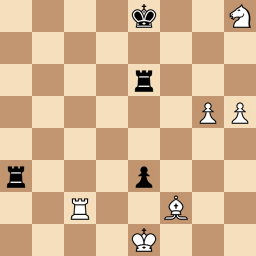
A second-hand study:
https://art.eg.org.ua/chessgame/bondari-khramtsevichm-1-0/
The judge “felt that pieces were artificially added to the introduction in some works” but he didn’t want to see them in the prize studies.
Pasman’s prize study demonstrates that two excellent sacrifices can turn a nice study into a wild position. Let’s call it Pasman’s paradox. I think it’s not easy to explain to newbies why they should avoid this paradox in their studies.
Serhiy, I would like to hear a more elaborate explanation of Pasman’s paradox. 😉 The basic scheme is pleasant, but simple and not terribly original. However, I liked the fact that the pieces were standing as if they had just been developed: 1. e4, 2. Nc3, 3. Bc4… and this is followed by two consecutive sacrifices with multiple capture options. This creates, in my opinion, a paradoxical effect and lifts the level of the study considerably.
Worship of sacrifices is beginner level in studies. If you and Martin liked them less you could see that they made the 2nd prize worse. Beauty + beauty doesn’t always make the whole study more beautiful. But children think a beautiful flower can’t spoil a painting.
You are wrong that the basic scheme is just pleasant and not very original. It is remarkable.
First prize zz with 6 pieces from database.
Logical try realized with brutal capture. Solution more natural than try.
Best study by Pasman. Sacrifices in introduction great! Long live the wild position!
I totally agree with you, Martin. In my opinion it is of my best studies.
Martin, what does “First prize zz with 6 pieces from database” mean?
Do you think that a study using a database is bad?!
Martin, one more question.
“Logical try realized with brutal capture…”
I couldn’t find a better Logical try in this zz. If you can show me and other colleagues a master class, then I ask you to do so. But there is no need to write bad or good. I’m eagerly awaiting your version.
Martin, how White’s knight and bishop sacrifices in the introduction relate to the main idea?
Here is one version without this cannon fodder and even with the white king playing…
The main idea of my study is not the final position. The main idea are 2 sacrifices in a raw of the knight, on square attacked by 3 of black pieces and after that of a bishop on a square attacked by 3 of black pieces and after that of a rook , on square that can be taken by 2 of black pieces etc. And all are clean sacrifices.
The sacrifices of the figures, even the most beautiful and unexpected ones, must still be connected with the main idea…
In your study, the white knight and bishop are from another set of figures.
All my study is very well connected. There is series of very good and rare sacrifices (on squares attacked by few pieces), that leads to final with very good flow . There is no introduction in my study. In your study as correctly pointed by Minski, the idea is 11.Kh2! In my opinion it is nice move and thematic try is good. This I think differently from Martin. But about the introduction I agree with Martin – it is poor – because of 2 brutal exchanges. Especially till move 6. I can understand 7.Rxe2! because of thematic try. I don’t compare between 2 studies, I accept the decision of the judge, I just say that my study is very good and it is among my best composed studies this year.
Michael, I don’t compare our studies either, but I’m waiting for Martin’s version. I hope he does better than me. 😎
My “version” is the first hm. I prefer to work on ideas that are not canned.
Do you not allow that I criticize your studies if I don’t have a better version? It is not my study therefore I don’t must do anything.
I respect the judge’s ruling, but I just like Michael’s study the best.
“Logical try realized with brutal capture”…
Martin, you haven’t convinced me, I’m waiting for your version of my study. You need to back up your words with action. Or are you just a talker?!
And you never answered why you indicated that my study was from the database zz. This is bad?
Why? You built it, not me. A book critic doesn’t write books either.
The tournament judge evaluated the studies for a month before making his verdict. And as soon as you see the results, you immediately write comments on the studies. Or maybe you need time to figure it out, maybe you’re mistaken?
And I hope, after all, to see your version.
Vladislav, you have 10.Kh3! and the logical try 10.Kh5? with later zz and BTM. You don’t need the capture on e2 or e1. I imagine there could be a better introduction. Maybe I don’t see the beauty. What do others think?
I would reformulate Martin’s criticism removing the part about “database zugzwang” because we evaluate the end product and not how the study was generated.
I actually like the scheme. I also agree that the scheme needs a logical try. I also agree (with Martin) that the present version is unsatisfactory because Rxe2 vs. Rc1 is a very rough way of implementing the difference between try and solution. You may be right, Vladislav, that no better version is available, but then, perhaps the scheme is not so great after all.
The logic in the first prize is bad and nobody has to prove that a better version exists before saying it is bad because even the best implementation can be bad.
Here’s the best version for the moment.
Serhiy, thank you for spending time looking for a better version. But you failed to do this. Capturing three queens is too high a price to shift the white king to the desired square. At the same time, on the right flank, all the pieces are already ready. It’s not that interesting or attractive…
A joke!
Jokes aside, a logical try after zz is as worthless as the absurd Rc1-Rxe1.
I would prefer this version
Not in words, but in deeds…
Michael, thank you for your master class! Learn, colleagues!..
Of course, you can also add the black knight’s sacrifice on h6, but it’s superfluous here…
3…Rh4+ is such a stupid move. Will you ever learn not to put this nonsense into the solution?
Only your moves are very clever
Your version was so ugly
Are you an expert now?
Slow down a little. You have a lot to learn yet.
The like to your version was from me, not from the author.
But for 3…Rh4 I add a dislike till you understand that this move doesn’t belong to the main line.
Serhiy, of course, we are still learning… But there is a feeling that you have learned everything a long time ago. Are you really a know-it-all?!
Before being smart look back at the WCCI 2019-21 where you didn’t find a single study by 2nd and 3rd place winners (Pervakov and me) worth more than 3 points. Gurgenidze is another smartass. This shows clearly who thinks that he knows it all.
Serhiy, should I have given your studies 3,5 points in the WCCI? Maybe 4 points? That’s why you’ve been angry with me for over a year? Stupid Tarasiuk underestimated the great Didukh?!
The output of your studies this time was weaker than in the 2016-18 cycle. In recent years, you have been too carried away with improving studies by different authors. Where are your original ideas, where are Didukh’s super-studies of the level of the WCCI champion 2010-12?
Maybe the problem is you?
The problem is your ego.
Now I looked at the WCCI 2019-21 table with scores…
If I gave all your six studies 4 points, you still wouldn’t become a champion… Right? What are you trying to achieve?
And the problem is you, your ideas and studies…
I didn’t know you are an expert in ideas.
Are you a big provocateur or am I wrong?!
You don’t answer my letters. I want to ask here. Why haven’t you posted an announcement of S. Bilokin-85 MT on your blog since April? Is this also a problem because of me?
Because of Russian fascists. They are not banned from participating.
Serhiy, your answer did not convince me. You’re contradicting yourself.
On your blog you have, for example, announcements of UAPA and ChessStar tournaments, some magazines in which authors from all over the world participate… Why then do you show these announcements on your blog?
And you know very well that authors from the RUS and BLR do not take part in S. Bilokin-85.
You are strange…
It’s a Ukrainian tourney. I asked the director about the ban. He said it will not be given in the announcement. And it is not given there. Do you see it?
This announcement will be added 1-2 months before the closing date. Like I did with another Ukrainian tourney without the ban where you are a judge. It’s a crime to have such announcements on the site for a longer time. Of course, I will not participate. Not because of you. But because a country in war shouldn’t let enemies participate in its tourneys.
You scratch your tongue like Trotsky!
Did you understand what you wrote?! 🙃
EVERYONE can also participate in the Ukrainian tournament “For the Triumph of International Law”. But you posted the announcement on your blog. Serhiy, where is your logic?
White king on h5.
1.g7 Rh2+ 2.Rh3!! …
2…Rxh3 3.Kg4 Rg1+!
…
Great version! (I agree with Serhiy that 3… Rg1+ should be the main line.) I would probably prefer wKh4 to Vladislav’s proposal with wKh5. It is true that 2. Rh3!! is then a genuine sacrifice, but I think the refusal to capture with 3. Kg4!! is even better.
I propose the Pasman test: every interesting study with an ugly introduction should be sent to Michael for technical improvement. He also rescued Avni’s study with the countersacrifice Rc5. 🙂
The “Pasman Test” surely will be the funniest thing you’ll read today 🙂
🙂
I can understand why you think that 3…Rg1 is better.
But I still think that 3…Rh4+ is better and should be main line.
Let’s explain why. For example in version with King on h4. Black plays 2…Rxh3+ and white refuses to capture : 3.Kg4!! With 3…Rg1+ black says “Let’s force him to capture with better rook position on g1”. Of course white is forced to capture and now black in zugzwang.
But if black plays instead 3…Rh4+ , he says “Let’s try sacrifice a rook and see if white refuses to capture again”. So, first difficulty for white is to decide if to capture on h4. And then after 4…Rg1 the difficulty is to find 5.Kh3!
I am sure that in chess game Carlsen would play 3…Rh4 .
And I think it is better main move also in study, because it leaves not easy choice for white. And it is also more aesthetic line. Of course 3…Rg1 remains secondary line.
I agree!
I believe that not-OTB composers would easily find these aspects irrelevant, preferring pure principles, but the retro-thought of the “players” on the board, even in a composed study, is important too.
Black can force White to open the box. And White knows this. Instead, Black adds another box. White knows that only one box contains the prize money. And he knows that Black could leave him no choice. Is this riddle difficult or stupid?
“Those who say they understand chess, understand nothing” — Robert Hübner
There is the final award:
https://arves.org/arves/images/PDF-Awards/Voia-100-MT-2023.pdf
https://eg.org.ua//?s=radu