Judge P.Gyarmati: “34 entries were received, 7 of which were joint-compositions. The works come from 26 authors from 13 countries. The average quality of the works was high”.
Slovak Chess Union – 100
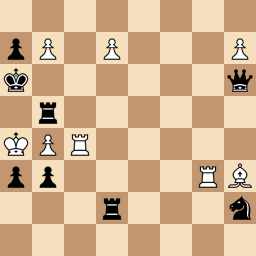
Judge P.Gyarmati: “34 entries were received, 7 of which were joint-compositions. The works come from 26 authors from 13 countries. The average quality of the works was high”.
The first prize is a breathtaking mix of sacrifices, pin-stalemate defense and a dissapearing trick via promotion to Rook. A crushing victory for White and for Martin!
I have looked at Martin’s study with several pairs of eyes of different age. 🙂
First, it was a sincere reaction of a little child at his father’s funny trick: “More, more, I want more!” Then a curious schoolboy started asking tons of questions:
Luckily, nowadays it is easy to answer such questions. A skillful student used some modern tools to find out quickly that there were only 4 studies with a promoted black bishop that moved into a pin, and in all of them White avoided stalemate by promoting to a bishop. Of course, an experienced perfectionist couldn’t help himself from improving the best two.
Finally, it was a joy for an old collector to realize that Martin’s study completes the collection of White’s minor promotions. It has the lacking promotions to R and N in one study!
Living through this study was enjoyable at every moment of ‘my life’. Maybe, it is a great study indeed.
I also liked Martin’s study very much! Original and very rich in content, with a lot of surprising twists.
The only thing where we disagree concerns the introduction, which is of course a minor issue. I would have started with 1. d7, kicking out bRc4 and bNh2 and accepting the non-moving wBf3. The study is rich enough that this does not matter and wBf3 participates in the game. One obtains a simple starting position with a natural and thematic key, and there is no distraction by black sacrifices in the introduction. There is even a very nice thematic try! Of course, this is a matter of taste.
1.d6-d7 was my first version, but the white bishop doesn’t move. After much consideration, I decided on the other version.
I would like to mention at this point that I find it insensitive to Jan Sprenger to publicly discuss any version of myself here without my consent.
Sorry for not mentioning that this is your version, not mine. It is just about cutting the first three moves, so I thought that it was obvious that you had considered it, too.
Martin, this version is not a big secret.
I think your choice depended not only on the bishop because it’s a bad practice to call big guys on the crowded board just to move a sleeping piece. You surely liked the sacrificial intro without extra white pieces. And those judges who disagree, may start from move 4. Am I right?
On the other hand, the critics who want to put your impressive picture on the wall in their museum are embarassed. If they exhibit the position without three moves to interest visitors, they can’t tell them it is the original. The answer “almost original” will not make visitors happy.
You may trick judges, but it’s not so easy to convince experts.
Serhiy, this is my best study of the last three years. I would like to thank you for your words of praise about the main idea of this study!
Over a year ago I had the version with 1.d6-d7! I like it because it is more natural and the key is an “antizielelement” (later this pawn an obstacle on d7). But the white bishop on f3 gave me no peace. I have tried to solve this problem very often. A year later I found the two black sacrifices. I generally agree with you that you shouldn’t take additional pieces if they are not thematic, but I was somehow fascinated that these pure sacrifices are possible in this scheme and yes, I like them! I don’t like that the position becomes more unnatural. But personally it bothers me even more when the white bishop doesn’t move. I asked many experts what I should do. There was no clear opinion. So I listen to my own feeling and I personally prefer the long version. I accept if you disagree, but in the end it’s up to me to decide and I can’t please everyone.