The judge decided that he understood the study better than the author and deleted the 5. Kh6? try after which we reach the mutual zugzwang position from the solution (Kh6, pawns a6, b7—Kh8, Rb8, Bg8) with White to move. I guess the reason was that Black has two ways to refuse to capture: 5… Re8!! and Rd8!!. I consider this choice completely irrelevant. Play transposes after 6. a6 Rxb8. The important thing is that Black recognizes the mutual zugzwang and waits with Rxb8 until White has committed his pawn.
It is unbelievable that the judge simply deleted the try. The line adds thematic content and the audience should get a chance to form their own opinion about whether the Re8/Rd8 dual is a problem. Nobody to whom I have shown the study has taken issue so far.
Regardless of technical considerations, this is one of the most memorable studies of the tournament. You can praise whatever you want in the other studies, there are very good ones, too—this study is among those that you will be most likely to remember.
The Minski/Huschenbeth study which inspired me is in the pgn.
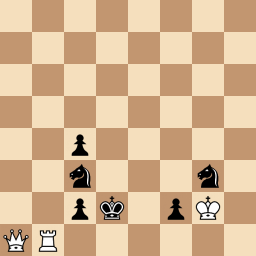
Razumenko’s famous study is memorable because the promoted knight is so dominant that the bishop can’t stop the b2-pawn. https://eg.org.ua/chessgame/razumenkov-0434-20a5a8-tt-m/
A zugzwang of a doubtful quality doesn’t make a study memorable.
The judge told me that it was not him who deleted 5. Kh6? from the pgn file. So I retract my accusation and apologize. Still I would like to know who was responsible for this act of vandalism.
Well, I am sorry for this…
The award I sent to the editor had the line, and the published award has the line, but later, when the editor asked me for a pgn, and I had to quickly create one from older notes, it seems I have sent one without it. The dual there I find it a minor one (a la Reti). I might have not included other variations having duals in other studies too, it is a habit of mine… In my view, those variations are not a legitimate part of the solution, and they just obfuscate the artistic part. By the way, all these studies have previously appeared in the magazine with the author’s solutions, and that should be the primary source.
Omitting lines because they have dual refutations always seemed kind of weird to me, because I would ideally want to answer all the questions an observer might have about my study. Sometimes a black move might have a beautiful simple refutation as well as a complicated one. Why not mention both? The difficult one can just be in a one move parentheses? Like this:
3….Ra8 4. Rh4+! (or 4. Ne2+-) Bxh4 5. g4#
3….Ra8 4. Rh4+! (or 4. Ne2+-) Bxh4 5. g4# This is fine for me. The line is clearly marked as not belonging to the solution but it is just a curiosity. 3….Ra8 4. Rh4+! Bxh4 5. g4# Definitely not okay! One would think that the solution features a variation ending with checkmate, adding value to the content of the study Such a case is misleading the public. Once I witnessed a study with three checkmate variations but only one of the was real…
Steffen’s point is different from mine. Ne2 and Rh4 are completely different ways to win. I think the notation he suggests is fine, and I also agree with Arpad that one needs to give the alternative solution in order not to mislead the reader.
In my study, however, 5… Re8 and 5… Rd8 express the same plan: refusing to capture to avoid the zugzwang after 5… Rxb8 6. a6 which is at the heart of the study, and to reach that position with White to me. Even irrespective of the beauty of the refutation, and the degree to which the dual is seen as annoying, this is clearly a thematic line belonging to the content to the study. Too bad only that 5. a6!! is more tempting than 5. Kh6?, even if they express the same idea.
I also don’t understand the judgement. The order of awards seems to me
accidental .The judge omitted this study from the award, not clear for me why. I don’t think it is less good then other prize or HM studies.
About my other study – I think it also deserved more.
(-) RBP/RB is usually a very messy analytical endgame. In this case, it is just less messy, but still… (see for example the 8…Bh2 line: https://syzygy-tables.info/?fen=1bR1r3/1P3k2/8/8/8/B7/5K2/8_b_-_-_0_1).
(-) These mutual zugwangs are not great discoveries. There must be tens of thousands similar in this endgame.
(+) The flow from the main line is good.
Overall, I wasn’t impressed enough to include it in the award in this strong tourney. There were better studies.
Regarding the award as a whole, I have the same impression as you, Michael. The level of the honorable mentions in particular does not look very high to me. I am not convinced by the first and second prize, while I like both the third prize (not a masterwork, but a good scheme with a strong introduction) and the special prize (great study, but given the predecessor, it is perhaps difficult to give more than a special prize). Will write on this topic more in the next days.
Your study with RBP against RB is a tricky case. When I was playing through it, I found it hard to understand the reason of why there is a mutual zugzwang. There is also a great choice of moves at each point, limiting the clarity of the overall impression. Perhaps I need to analyze more closely: will do so.
For your 3rd commendation, this is for me a typical honorable mention. Delightful miniature with good technique. The only problem is that the final is not really connected to the first phase. Still, a good study. I would not overemphasize the switchbacks, by the way, since I struggle to see a lot of aesthetic value in them.
Thank you Jan for your comments. I believe there were other very good studies that were not chosen for the award. Even I have third study, that is not less good that other commendations here. Indeed I am not impressed by the prizes / honorable mentions . The judge presents various excuses as to why other studies did not appeal to him, but the general impression is that in choosing the winning studies he referred more to the author’s name than to the study itself. And I won’t begin to detail each study. Anyone can see it. If I’m wrong, then we’ll see the opposite proof in the FIDE album that he judges or we’ll see further confirmation of my words there.
Jan is right: the waiting move 5…Re8/Rd8 in the logical try of his study is only a minor dual. Of course it can’t be removed.
Michael, you’re claiming that the judge looks at names, not studies. That’s an assumption you can’t prove. You should be more careful with your statements.
I haven’t seen you often as a judge. Criticizing is easy. You should prove yourself first! Arpad Rusz is an experienced judge who has agreed to grade 1000 studies for the FIDE Album. We can only thank him for that! A little more respect and more objectivity gentlemen!
I have got a pgn with 48 studies and no names from the editor.
I have chosen the studies which I liked.
I did the ranking.
I have started to edit the award.
I realized that I needed the names too…
I have looked for the names in the online Variantim issues.
After learning that the first three prizes are all by the same MP, I have thrown away from the award two of them and put the third one as a commendation. 😉
Martin, I stand by my words regarding the judgement, but everyone can look on the results and decide what he thinks.
I think you are a smart man and you see that I am right also because of the judge’s comments here in the forum that shows one of 2 things – or his misunderstanding in studies or his panic because he finds it hard to face the truth.
But anyway I want to wait for the results of the Fide Album to confirm what I think about the judge.
But I’m very surprised – you said you have to thank AR for agreeing to judge the event.
I think you should thank the judges for a good judgment at end of the event.
Because bad judgment only damages the reputation and sportsmanship of the chess composing. And a judge must be punished for unfair judgment (of course if it is unfair – everyone can decide himself if it is the case here).
And you also said that I am critisizing others and you didn’t see my judgement yet – I guess you see it in every tournament – I usually send to tournaments at least one study with a prize level (with some exceptions when I am not sure about judgement level) – and you can see that my judgment is OK by my results. This event I wanted to pay special respect to Yochanan Afek and knew that the event should be strong – so I sent 3 very good studies – 2 of them, that you saw here, I believed prize level or at least one prize and second high HM and the third commendation level. So you can understand my surprise when I saw the final results and also when I saw the winning studies.
About MSV tournament results – they are ready and will be sent to the manager soon.
By the way , I really liked one of your studies there..
And about the difficulty to find judge to grade 1000 studies – may be I can judge next FIDE album if there is difficulty like this.
Steffen, I am happy that you also like my 3rd commendation study and evaluate it much more then HM.
Jan, the switchback with changed pieces on the board is something special for this study and what gives the study special aesthetic value – but to give HM for the study may be still normal.
Michael, thank you for your willingness to judge the next FIDE album! I’m not sure if the people in charge will “let you” because you should have some experience as a judge beforehand. Anyway, I’ll suggest you. I think you can do this job well.
Thank you to everyone who is taking on this great work.
I never give thanks for the “performance” of the judge. I assume that every FIDE Album judge has the necessary competence. We all have to live with differences in the assessments of the individual judges.
Only once did I intervene as a judge when a director wanted to manipulate the rating by “ordering” that we as judges should give half a point more to each study. That’s cheating! This director was then replaced and everyone involved knows who it is. Since then I have not sent any more studies to this gentleman, wherever he is appointed judge or director.
If you’re waiting for the FIDE Album 2019-21 ratings, I have to disappoint you. The individual judge points are not public for good reason. There would be endless discussions about individual ratings. This leads to nothing. I think that Arpad and Steffen are rather strict judges and Branislav a more moderate judge. We’ll see… In the end there is only the information about studies that are represented in the album.
This is my 4th time working on the FIDE album. It’s really a lot of work (and I still have a real job…). You never get a bouquet of flowers, but above all there is a lot of criticism. I “put up with it” and I’m still convinced of the FIDE Album project. That’s why I support that.
I can understand your disappointment. You have 3 studies in the tournament that you are very confident about. And you’re very confident…
In every tournament you have to live with the fact that other people don’t find the study, which you find wonderful, so great. Occasionally I’m “appalled” by the judge’s verdict. Serhiy didn’t award a study of mine in a tournament. By now every expert has told me that this study is not that big. So I have to accept that. Your own perception in your own studies is often too subjective. So you should always accept what the judge decides, otherwise please don’t participate!
I was really annoyed by your comment that Arpad only looks at names and doesn’t evaluate the studies. That’s really arrogant and disrespectful and you have no right to do that! You can factually disagree, but you should refrain from such evil allegations!
Again I don’t agree with you about Arpad judgement. If I see that the judge is judging people and not studies I will not tell this ? I will allow this principle to continue ? For sure I will not send next time studies for award to be judged by judge like this and I will do all I can not to allow him to judge in big tournaments like Fide Album. In these tournaments must be only judges that we are sure thar are fair judges. I totally not understand your attitude in this case. Because you must support me in this.
And about not publishing points of every judge in album ? I don’t think it is fair. I know that if there is difference between points given by different judges – this must be explained. And I will claim to receive information about this.
And you also contradict yourself – earlier you wrote that you don’t have people to judge the album because it’s hard work and now when I offer my services you say I don’t have enough knowledge and experience?? I am an international master with 50 years of experience in chess, all this time I am also interested in studies and I have received many awards for composing studies, I can composes on different styles and only specific style – what is also very important for good judge – and you don’t look on that factor. I also won the World Cup – and I don’t have enough knowledge ?? This contradiction in your words raises the suspicion that the entire management of this album is also not done properly
Good gracious! I have offended Your Highness! I don’t doubt your skills in competitive chess at all. I only described to you very factually that the main person responsible, Harry Fougiaxis, makes sure that the FIDE judges employed have a certain amount of experience. Like I said, if you ask me, I’d encourage you to do it. This is not about tournament chess at all, but about judges in artistic chess! I only see a few tournaments from you. 15 years ago you still submitted 5-7 tournaments and got the title FIDE Judge before you were used for such important tournaments. You’re speaking as a newbie here, like you know everything better and you think you can judge anything and everything. That’s called overbearing and arrogant.
Why Mr. Selivanov offered me to judge this year’s Fide World Cup? Believe me, he knows my background just as well as you do. He just probably has a better understanding of who should be a judge. I declined his offer for 2023 because I simply preferred to compete this year and not to judge. So Selivanov chose of Djurasevich is also an excellent choice and I guess he will be a good judge.
We’re talking about two different things. World Cup is a major tournament. I have absolutely nothing against you judging this tournament next year. I agree with Andrey.
The other topic is judge for the FIDE Album. I have seen candidates who have at least as much experience as you being rejected (for the time being) because they have judged too few study tournaments. I wasn’t questioning your other skills at all.
But it seems to me that because you are an OTB International Master, you believe that you are “automatically” competent for any task in problem chess. That’s what many think, but it’s “apples and pears”.
The rules for the FIDE Albums are of course a compromise and have been the subject of lively debate for the last few decades. Everyone who participates in the FIDE Album indirectly accepts these rules. Maybe there are better rules. Anyone can submit an application in Batumi. The often made insinuation – that is “unfair” etc. leads to nothing! I notice from this discussion that it is absolutely right not to publish all the evaluations of all studies.
What makes a study good? The judgment of a judge or several judges? No! A study retains the same variants, the same punchlines, etc., even after a judge’s verdict. Studies are art. The sense of whether a study is particularly successful or not will always involve a large percentage of subjectivity, barring obvious shortcomings. But even dealing with a partial anticipation will cause a big difference in the opinion of the experts.
Let’s all just relax and take it easy. We’re just a small group of artists. Each of us can print out our favorite studies as a diagram and place them in the living room.
I’m looking forward to the next masterpieces by Oleg, Steffen, Serhiy, Vladislav, Jan (2x), Amatzia, Yochanan and many others and of course also by Michael!
I did not doubt the aesthetic value of Michael’s 3rd commendation. I said that I am not convinced of the aesthetic value of switchback play, unless it joins forces with a different theme.
This study has been constructed with very good technique, as in most of Michael’s studies, but I don’t see a singular theme which is strongly expressed. The final switchbacks, 6. Ra4 and 9. Ra8, look somewhat accidental to me. Therefore I was assessing this study at HM level. Of course, in a weaker tournament, a prize could be an option thanks to the author’s technique and the economy of the setting.
If a similar Switchback play was featured in a WIN study, forcing black to capture the d-pawn, then yes, it should be placed higher. Now it seems more like a failed positional draw study. And the final phase with RB vs Q is totally anticipated. I still cannot see it higher than a commendation, sorry…
The idea to remove a white pawn from a zz-position (or add a black pawn) in order to make the zugzwang disappear was first shown in my winning study in the Sochnev-2014 JT. The judge was impressed: “White discards his pawn instead of playing for the zugzwang! Wonderful logic! I kneel in admiration…”
This is the first realization of this idea with a black pawn. The idea needs 3 lines:
a try with a mutual zugzwang BTM that Black is able to turn into
a try with the same mutual zugzwang WTM;
the main line with the position that was zz in the try, but thanks to a change in material the zz is not there anymore.
Your Sochnev-JT study is indeed a wonderful and admirable composition, worthy of every collection. Compelling both in content and form (the capture of wBh2 is a negligible shortcoming).
I do not think that your first prize from this tournament is at the same level. Although I like it better after looking at it more closely. The idea is intellectually challenging, the study is coherent, and of course, 2. Rf1!! is a great move. On the other side, the material and the play are a bit sterile and I am not a big fan of the initial position.
The Black duals in the 2. Rc1? try (after 7… Nb6 8. Qe8 c1Q 9. Qh5+ etc.) are not a big deal since the important point is the Qb2+ countercheck, which is common to all lines. Still, they dilute the impression of a properly logical study.
All things taken together, I tend to agree with the judge that this study should get a prize. But it is a cold beauty.
Well, I don’t think I need your opinion. At least, till the moment when your telescope will be able to discern the ideas that are far beyond its range now.
I already commented on the first prize in a separate post. An ambitious idea in an economic setting with a paradoxical key move. On the downside, the play and the material constellation do not appeal to me that much, and the impression of a logical is diluted by the (minor) duals after 2. Rc1? … 7… Nb6! 8. Qe8+ c1=Q 9. Qh5+. Still, a prize is adequate for the realization of the idea. (3 points)
The second prize has two major problems. First, the scheme is not of particular interest. The lines are straightforward and technical. I do not think that the presence/absence of the symmetry raises it to a higher level. Why should this be a value in itself, at least when so few pieces are involved? Moreover, for me, 7. Ke5! is not a double exclamation mark move either since it is at least as plausible as the capture, which gives the knight the possibility of moving with a check.
the introduction only serves to set up the final. The basic scheme can be realized simply with a black pawn on e6 and 1. Ke7-f6! (1. Kd6?) Nc7-e8+ 2.Kd6-e5! (2. Kxe6?) etc. What are the captures and the additional material really good for? In a tactical scheme, I would appreciate the fluent character of the introduction, such as the nice key move (1. e6!) and the pleasant play throughout (1.. c5+!, 2. Kb5!, 4. e8=Q!). But it does not square well with the author’s technical scheme. (2 points)
The third prize has an original positional draw, although I must say that the crammed position of the black king on h4 in the initial position is not my piece of cake. The strong point of this study is the introduction with Bb6!!, which highlights the importance of having the pawn on d3 and not on d4. A prize is possible (2,5 points).
The special prize corrects the cooked roundtrip study by Dolgov and adds a highly interesting thematic try. It is not irrelevant whether the rook is on the fourth or the fifth rank! It is slightly annoying that the pawns are standing around on b3 and e3, and that h4 has to be captured, but on the other side, the authors managed to make move all pieces. Very good work! (3 points)
EDIT: I forgot the fourth prize. Sorry! But I am not enthusiastic about the long queen manoeuver either. There are some intelligent decisions by White: he first needs to provoke d5-d4, and to eliminate the h-pawn before picking up the a-pawn (which is more natural). Still, the high number of checks is straining my attention. The final is known.
Jan, of course, I saw different possibilities of my scheme, including yours…
It was important for me in my future study to bring all the thematic figures to the key position in the right places. It was very important that the black e6-pawn play… I wonder if you can find an introduction to the scheme with the king on e7?! You can use the help of your telescope. 🔭 And do not rush, Jan, – not everything is so simple! 😎
And the last. For the first time in my study, both whites and blacks implement the same idea of asymmetry. Isn’t it unique and new? Perhaps in the future there will be more studies with a similar synthesis, but my work in this direction is the first attempt…🚀
Thanks for explaining the reasons why you decided to set up the study in this way, Vladislav. I would not have had the idea that it is important that the e6 pawn has moved, but I will think about whether this is desirable or not. Such exchanges are great about this blog!
I do not claim that it is easy to set up a “technical” introduction with wKe7 or wKg7. I just wanted to isolate the basic scheme with WTM and then compare it to the final result with introduction. This is an 11-men study (compared to the six pieces of the scheme). Of course, the play is pleasant and elegant, but it feels somehow disconnected to what follows. Is it worth it, just for the sake of bringing the e6 pawn to its place?
(Of course, it is easier to complain than to improve. I tried a little bit, but found nothing appealing.)
My other problem with your study is probably that I do not feel attracted by symmetry/asymmetry schemes unless there is a particularly interesting pointe in the play. Rusz has composed in this style himself, so it is unsurprising that he appreciated your work more than I do.
I hope that you and your friends and family are doing well!
Pawn is not a man. So, it’s better to measure schemes in major pieces. Vladislav didn’t use major white pieces. That’s why the study is pleasant and elegant but according to your calculations 11/6 it shouldn’t be. Probably your algorithm sucks.
Somebody here has trouble reading what I wrote or wants to troll me a bit. 😉 The problem with the introduction is not that there are 11 men on the board. The problem is that the introduction feels disconnected from the final. Adding the pawns and the black bishop leads to fluent play, but what follows is a very technical final. This is, in my eye, a mismatch.
The 2nd prize has an asymetry idea that is very much appreciated by the judge. Of course, he was all subjectivity here. The composer scored from a penalty kick. We watched goalkeeper Knight take his place on the goal line and the striker King feint to e5 before shooting in the h-corner. No VAR in chess composition yet in order to check if there were grounds to give a penalty for such a slight-push idea.
The 3rd prize is solved if Black plays Qxf7 at once instead of Qa7+. This means that Bb6! is outside the content. It’s a shame that GM composer can’t make a good introduction without Black’s cooperative play. Although he knows that it’s a foul play.
It’s an endless torment to watch Queen picking enemy pawns for 20 moves before the final combination. I can’t explain why this study was awarded at all. It’s a perfect demonstration what a rubbish idea looks like.
Systematic movement with queen and rook checks is not a healthy idea. I doubt as well that it’s a healthy decision to bring all the black rook-spectators to their places so that they could watch their king fighting for his life against two white sadists. There’s nothing interesting for me in this long show.
Martin will not agree that Qa7+ instead of Qxf7 is foul play. We talked about this after Moscow-2021, where you made the same objection to his second prize (insertion of 3… Qd7 4. Kg8). So I think he constructed this line in good faith. As to his reasons for including 3… Qa7+ as main line, I guess he will tell them himself. 😉 I am looking forward to your exchange about the topic!
Moving on to the honorable mentions. The first honorable mention (Hansen/Nielsen) has a cute, but limited idea. I guess it was thanks to Steffen’s technique that the introduction is appealing: 8. f6! foreshadows the 10. e4!! pointe, and the play with the pin motives is a distant reminder of Steffen’s large-scale studies. On the downside, the initial position looks crammed: Black needs a couple of moves just for disentangling his pieces. A HM looks adequate to me.
I do not think that the echo in the second honorable mention (Hlinka/Kekely) is interesting enough to justify a very simple idea. At most a commendation.
Neither the initial checks nor the choice of the queen square in the third honorable mention (Polasek/Vlasak) are of any interest to me. No white key. I am surprised that this got published at all.
I like the aristocratic material distribution in the fourth honorable mention (Rusinek), but the play looks a bit too analytic to me. Yes, the mutual zugzwang is notable and the thematic try 5. Ne5 is cute, but still, there is a feeling of a computer study to this one. This is very difficult to judge and probably a matter of taste.
The echo mates in the fifth honorable mention (Kekely/Osintsev) with 2… Ka5 and 2.. Kb5 (and the respective tries) are notable, but I simply find the position too chaotic to be really enthusiastic about it. I agree that this is again a study whose evaluation depends a bit on personal taste. All in all, a HM looks fair to me.
What I do not understand is the judge’s comment “Sincerely, in this study I was impressed only by the play after the fifth move with the two echo mate positions. I hope others will also like those rook sacrifices from the foreplay.” I thought the point of the study are the echo mates in 2… Ka5 and 2… Kb5! If you look at the study from move 5 onwards, you have only one main line with a mildly interesting try.
And now, I have heaped enough of my nonsense on Serhiy and the readers of this blog. Time to get some work done. 😉
Vladislav Tarasiuk
3 лет назад
The first prize with the game of a lonely shepherd did not impress. And without the bearish help of the black king, White would not have succeeded at all.
Arpad Rusz
3 лет назад
@Jan: I see echo mates only after 5.Kd3! and 5.Kb3? (9. Bd6# and 9.Bb6#). Where do you see the (echo) mate in the variation which starts with 2…Kb2 ?
I find the mate with Nc4# after 2… Kb5 close enough to the mainline with Rd6# to count as an echo. After all, the white piece configuration is the same, shifted two lines to the left. Sure it would have been preferable to close that line with Rb6#, but I count it as part of the content nonetheless.
The judge decided that he understood the study better than the author and deleted the 5. Kh6? try after which we reach the mutual zugzwang position from the solution (Kh6, pawns a6, b7—Kh8, Rb8, Bg8) with White to move. I guess the reason was that Black has two ways to refuse to capture: 5… Re8!! and Rd8!!. I consider this choice completely irrelevant. Play transposes after 6. a6 Rxb8. The important thing is that Black recognizes the mutual zugzwang and waits with Rxb8 until White has committed his pawn.
It is unbelievable that the judge simply deleted the try. The line adds thematic content and the audience should get a chance to form their own opinion about whether the Re8/Rd8 dual is a problem. Nobody to whom I have shown the study has taken issue so far.
Regardless of technical considerations, this is one of the most memorable studies of the tournament. You can praise whatever you want in the other studies, there are very good ones, too—this study is among those that you will be most likely to remember.
The Minski/Huschenbeth study which inspired me is in the pgn.
Razumenko’s famous study is memorable because the promoted knight is so dominant that the bishop can’t stop the b2-pawn.
https://eg.org.ua/chessgame/razumenkov-0434-20a5a8-tt-m/
A zugzwang of a doubtful quality doesn’t make a study memorable.
Blah blah blah. Razumenko’s study is mediocre and you know perfectly well why. Neither the content nor the form is convincing.
If Razumenko’s study were mediocre I wouldn’t have taken an effort to correct it.
The judge told me that it was not him who deleted 5. Kh6? from the pgn file. So I retract my accusation and apologize. Still I would like to know who was responsible for this act of vandalism.
Well, I am sorry for this…
The award I sent to the editor had the line, and the published award has the line, but later, when the editor asked me for a pgn, and I had to quickly create one from older notes, it seems I have sent one without it. The dual there I find it a minor one (a la Reti). I might have not included other variations having duals in other studies too, it is a habit of mine… In my view, those variations are not a legitimate part of the solution, and they just obfuscate the artistic part. By the way, all these studies have previously appeared in the magazine with the author’s solutions, and that should be the primary source.
Omitting lines because they have dual refutations always seemed kind of weird to me, because I would ideally want to answer all the questions an observer might have about my study. Sometimes a black move might have a beautiful simple refutation as well as a complicated one. Why not mention both? The difficult one can just be in a one move parentheses? Like this:
3….Ra8 4. Rh4+! (or 4. Ne2+-) Bxh4 5. g4#
3….Ra8 4. Rh4+! (or 4. Ne2+-) Bxh4 5. g4# This is fine for me. The line is clearly marked as not belonging to the solution but it is just a curiosity.
3….Ra8 4. Rh4+! Bxh4 5. g4# Definitely not okay! One would think that the solution features a variation ending with checkmate, adding value to the content of the study Such a case is misleading the public. Once I witnessed a study with three checkmate variations but only one of the was real…
Steffen’s point is different from mine. Ne2 and Rh4 are completely different ways to win. I think the notation he suggests is fine, and I also agree with Arpad that one needs to give the alternative solution in order not to mislead the reader.
In my study, however, 5… Re8 and 5… Rd8 express the same plan: refusing to capture to avoid the zugzwang after 5… Rxb8 6. a6 which is at the heart of the study, and to reach that position with White to me. Even irrespective of the beauty of the refutation, and the degree to which the dual is seen as annoying, this is clearly a thematic line belonging to the content to the study. Too bad only that 5. a6!! is more tempting than 5. Kh6?, even if they express the same idea.
I also don’t understand the judgement. The order of awards seems to me
accidental .The judge omitted this study from the award, not clear for me why. I don’t think it is less good then other prize or HM studies.
About my other study – I think it also deserved more.
(-) RBP/RB is usually a very messy analytical endgame. In this case, it is just less messy, but still… (see for example the 8…Bh2 line: https://syzygy-tables.info/?fen=1bR1r3/1P3k2/8/8/8/B7/5K2/8_b_-_-_0_1).
(-) These mutual zugwangs are not great discoveries. There must be tens of thousands similar in this endgame.
(+) The flow from the main line is good.
Overall, I wasn’t impressed enough to include it in the award in this strong tourney. There were better studies.
Regarding the award as a whole, I have the same impression as you, Michael. The level of the honorable mentions in particular does not look very high to me. I am not convinced by the first and second prize, while I like both the third prize (not a masterwork, but a good scheme with a strong introduction) and the special prize (great study, but given the predecessor, it is perhaps difficult to give more than a special prize). Will write on this topic more in the next days.
Your study with RBP against RB is a tricky case. When I was playing through it, I found it hard to understand the reason of why there is a mutual zugzwang. There is also a great choice of moves at each point, limiting the clarity of the overall impression. Perhaps I need to analyze more closely: will do so.
For your 3rd commendation, this is for me a typical honorable mention. Delightful miniature with good technique. The only problem is that the final is not really connected to the first phase. Still, a good study. I would not overemphasize the switchbacks, by the way, since I struggle to see a lot of aesthetic value in them.
Thank you Jan for your comments. I believe there were other very good studies that were not chosen for the award. Even I have third study, that is not less good that other commendations here. Indeed I am not impressed by the prizes / honorable mentions . The judge presents various excuses as to why other studies did not appeal to him, but the general impression is that in choosing the winning studies he referred more to the author’s name than to the study itself. And I won’t begin to detail each study. Anyone can see it. If I’m wrong, then we’ll see the opposite proof in the FIDE album that he judges or we’ll see further confirmation of my words there.
Jan is right: the waiting move 5…Re8/Rd8 in the logical try of his study is only a minor dual. Of course it can’t be removed.
Michael, you’re claiming that the judge looks at names, not studies. That’s an assumption you can’t prove. You should be more careful with your statements.
I haven’t seen you often as a judge. Criticizing is easy. You should prove yourself first! Arpad Rusz is an experienced judge who has agreed to grade 1000 studies for the FIDE Album. We can only thank him for that! A little more respect and more objectivity gentlemen!
Well, this was the process.
Martin, I stand by my words regarding the judgement, but everyone can look on the results and decide what he thinks.
I think you are a smart man and you see that I am right also because of the judge’s comments here in the forum that shows one of 2 things – or his misunderstanding in studies or his panic because he finds it hard to face the truth.
But anyway I want to wait for the results of the Fide Album to confirm what I think about the judge.
But I’m very surprised – you said you have to thank AR for agreeing to judge the event.
I think you should thank the judges for a good judgment at end of the event.
Because bad judgment only damages the reputation and sportsmanship of the chess composing. And a judge must be punished for unfair judgment (of course if it is unfair – everyone can decide himself if it is the case here).
And you also said that I am critisizing others and you didn’t see my judgement yet – I guess you see it in every tournament – I usually send to tournaments at least one study with a prize level (with some exceptions when I am not sure about judgement level) – and you can see that my judgment is OK by my results. This event I wanted to pay special respect to Yochanan Afek and knew that the event should be strong – so I sent 3 very good studies – 2 of them, that you saw here, I believed prize level or at least one prize and second high HM and the third commendation level. So you can understand my surprise when I saw the final results and also when I saw the winning studies.
About MSV tournament results – they are ready and will be sent to the manager soon.
By the way , I really liked one of your studies there..
And about the difficulty to find judge to grade 1000 studies – may be I can judge next FIDE album if there is difficulty like this.
Steffen, I am happy that you also like my 3rd commendation study and evaluate it much more then HM.
Jan, the switchback with changed pieces on the board is something special for this study and what gives the study special aesthetic value – but to give HM for the study may be still normal.
Michael, thank you for your willingness to judge the next FIDE album! I’m not sure if the people in charge will “let you” because you should have some experience as a judge beforehand. Anyway, I’ll suggest you. I think you can do this job well.
Thank you to everyone who is taking on this great work.
I never give thanks for the “performance” of the judge. I assume that every FIDE Album judge has the necessary competence. We all have to live with differences in the assessments of the individual judges.
Only once did I intervene as a judge when a director wanted to manipulate the rating by “ordering” that we as judges should give half a point more to each study. That’s cheating! This director was then replaced and everyone involved knows who it is. Since then I have not sent any more studies to this gentleman, wherever he is appointed judge or director.
If you’re waiting for the FIDE Album 2019-21 ratings, I have to disappoint you. The individual judge points are not public for good reason. There would be endless discussions about individual ratings. This leads to nothing. I think that Arpad and Steffen are rather strict judges and Branislav a more moderate judge. We’ll see… In the end there is only the information about studies that are represented in the album.
This is my 4th time working on the FIDE album. It’s really a lot of work (and I still have a real job…). You never get a bouquet of flowers, but above all there is a lot of criticism. I “put up with it” and I’m still convinced of the FIDE Album project. That’s why I support that.
I can understand your disappointment. You have 3 studies in the tournament that you are very confident about. And you’re very confident…
In every tournament you have to live with the fact that other people don’t find the study, which you find wonderful, so great. Occasionally I’m “appalled” by the judge’s verdict. Serhiy didn’t award a study of mine in a tournament. By now every expert has told me that this study is not that big. So I have to accept that. Your own perception in your own studies is often too subjective. So you should always accept what the judge decides, otherwise please don’t participate!
I was really annoyed by your comment that Arpad only looks at names and doesn’t evaluate the studies. That’s really arrogant and disrespectful and you have no right to do that! You can factually disagree, but you should refrain from such evil allegations!
Again I don’t agree with you about Arpad judgement. If I see that the judge is judging people and not studies I will not tell this ? I will allow this principle to continue ? For sure I will not send next time studies for award to be judged by judge like this and I will do all I can not to allow him to judge in big tournaments like Fide Album. In these tournaments must be only judges that we are sure thar are fair judges. I totally not understand your attitude in this case. Because you must support me in this.
And about not publishing points of every judge in album ? I don’t think it is fair. I know that if there is difference between points given by different judges – this must be explained. And I will claim to receive information about this.
And you also contradict yourself – earlier you wrote that you don’t have people to judge the album because it’s hard work and now when I offer my services you say I don’t have enough knowledge and experience?? I am an international master with 50 years of experience in chess, all this time I am also interested in studies and I have received many awards for composing studies, I can composes on different styles and only specific style – what is also very important for good judge – and you don’t look on that factor. I also won the World Cup – and I don’t have enough knowledge ?? This contradiction in your words raises the suspicion that the entire management of this album is also not done properly
Good gracious! I have offended Your Highness! I don’t doubt your skills in competitive chess at all. I only described to you very factually that the main person responsible, Harry Fougiaxis, makes sure that the FIDE judges employed have a certain amount of experience. Like I said, if you ask me, I’d encourage you to do it. This is not about tournament chess at all, but about judges in artistic chess! I only see a few tournaments from you. 15 years ago you still submitted 5-7 tournaments and got the title FIDE Judge before you were used for such important tournaments. You’re speaking as a newbie here, like you know everything better and you think you can judge anything and everything. That’s called overbearing and arrogant.
Why Mr. Selivanov offered me to judge this year’s Fide World Cup? Believe me, he knows my background just as well as you do. He just probably has a better understanding of who should be a judge. I declined his offer for 2023 because I simply preferred to compete this year and not to judge. So Selivanov chose of Djurasevich is also an excellent choice and I guess he will be a good judge.
We’re talking about two different things. World Cup is a major tournament. I have absolutely nothing against you judging this tournament next year. I agree with Andrey.
The other topic is judge for the FIDE Album. I have seen candidates who have at least as much experience as you being rejected (for the time being) because they have judged too few study tournaments. I wasn’t questioning your other skills at all.
But it seems to me that because you are an OTB International Master, you believe that you are “automatically” competent for any task in problem chess. That’s what many think, but it’s “apples and pears”.
The rules for the FIDE Albums are of course a compromise and have been the subject of lively debate for the last few decades. Everyone who participates in the FIDE Album indirectly accepts these rules. Maybe there are better rules. Anyone can submit an application in Batumi. The often made insinuation – that is “unfair” etc. leads to nothing! I notice from this discussion that it is absolutely right not to publish all the evaluations of all studies.
What makes a study good? The judgment of a judge or several judges? No! A study retains the same variants, the same punchlines, etc., even after a judge’s verdict. Studies are art. The sense of whether a study is particularly successful or not will always involve a large percentage of subjectivity, barring obvious shortcomings. But even dealing with a partial anticipation will cause a big difference in the opinion of the experts.
Let’s all just relax and take it easy. We’re just a small group of artists. Each of us can print out our favorite studies as a diagram and place them in the living room.
I’m looking forward to the next masterpieces by Oleg, Steffen, Serhiy, Vladislav, Jan (2x), Amatzia, Yochanan and many others and of course also by Michael!
Well, I don’t struggle to see the aesthetic value of the 3rd commendation. I think it is much more than an hm.
For none-GM’s or IM’s the other study is hardly memorable.
I did not doubt the aesthetic value of Michael’s 3rd commendation. I said that I am not convinced of the aesthetic value of switchback play, unless it joins forces with a different theme.
This study has been constructed with very good technique, as in most of Michael’s studies, but I don’t see a singular theme which is strongly expressed. The final switchbacks, 6. Ra4 and 9. Ra8, look somewhat accidental to me. Therefore I was assessing this study at HM level. Of course, in a weaker tournament, a prize could be an option thanks to the author’s technique and the economy of the setting.
If a similar Switchback play was featured in a WIN study, forcing black to capture the d-pawn, then yes, it should be placed higher. Now it seems more like a failed positional draw study. And the final phase with RB vs Q is totally anticipated. I still cannot see it higher than a commendation, sorry…
The idea to remove a white pawn from a zz-position (or add a black pawn) in order to make the zugzwang disappear was first shown in my winning study in the Sochnev-2014 JT. The judge was impressed: “White discards his pawn instead of playing for the zugzwang! Wonderful logic! I kneel in admiration…”
This is the first realization of this idea with a black pawn. The idea needs 3 lines:
Your Sochnev-JT study is indeed a wonderful and admirable composition, worthy of every collection. Compelling both in content and form (the capture of wBh2 is a negligible shortcoming).
I do not think that your first prize from this tournament is at the same level. Although I like it better after looking at it more closely. The idea is intellectually challenging, the study is coherent, and of course, 2. Rf1!! is a great move. On the other side, the material and the play are a bit sterile and I am not a big fan of the initial position.
The Black duals in the 2. Rc1? try (after 7… Nb6 8. Qe8 c1Q 9. Qh5+ etc.) are not a big deal since the important point is the Qb2+ countercheck, which is common to all lines. Still, they dilute the impression of a properly logical study.
All things taken together, I tend to agree with the judge that this study should get a prize. But it is a cold beauty.
Well, I don’t think I need your opinion. At least, till the moment when your telescope will be able to discern the ideas that are far beyond its range now.
Nobody needs my opinion. That said, I prefer a reliable telescope with limited range to a distorted deep-sky telescope. 😉
So here is my take on the prizes and HMs.
I already commented on the first prize in a separate post. An ambitious idea in an economic setting with a paradoxical key move. On the downside, the play and the material constellation do not appeal to me that much, and the impression of a logical is diluted by the (minor) duals after 2. Rc1? … 7… Nb6! 8. Qe8+ c1=Q 9. Qh5+. Still, a prize is adequate for the realization of the idea. (3 points)
The second prize has two major problems. First, the scheme is not of particular interest. The lines are straightforward and technical. I do not think that the presence/absence of the symmetry raises it to a higher level. Why should this be a value in itself, at least when so few pieces are involved? Moreover, for me, 7. Ke5! is not a double exclamation mark move either since it is at least as plausible as the capture, which gives the knight the possibility of moving with a check.
the introduction only serves to set up the final. The basic scheme can be realized simply with a black pawn on e6 and 1. Ke7-f6! (1. Kd6?) Nc7-e8+ 2.Kd6-e5! (2. Kxe6?) etc. What are the captures and the additional material really good for? In a tactical scheme, I would appreciate the fluent character of the introduction, such as the nice key move (1. e6!) and the pleasant play throughout (1.. c5+!, 2. Kb5!, 4. e8=Q!). But it does not square well with the author’s technical scheme. (2 points)
The third prize has an original positional draw, although I must say that the crammed position of the black king on h4 in the initial position is not my piece of cake. The strong point of this study is the introduction with Bb6!!, which highlights the importance of having the pawn on d3 and not on d4. A prize is possible (2,5 points).
The special prize corrects the cooked roundtrip study by Dolgov and adds a highly interesting thematic try. It is not irrelevant whether the rook is on the fourth or the fifth rank! It is slightly annoying that the pawns are standing around on b3 and e3, and that h4 has to be captured, but on the other side, the authors managed to make move all pieces. Very good work! (3 points)
EDIT: I forgot the fourth prize. Sorry! But I am not enthusiastic about the long queen manoeuver either. There are some intelligent decisions by White: he first needs to provoke d5-d4, and to eliminate the h-pawn before picking up the a-pawn (which is more natural). Still, the high number of checks is straining my attention. The final is known.
Jan, of course, I saw different possibilities of my scheme, including yours…
It was important for me in my future study to bring all the thematic figures to the key position in the right places. It was very important that the black e6-pawn play… I wonder if you can find an introduction to the scheme with the king on e7?! You can use the help of your telescope. 🔭 And do not rush, Jan, – not everything is so simple! 😎
And the last. For the first time in my study, both whites and blacks implement the same idea of asymmetry. Isn’t it unique and new? Perhaps in the future there will be more studies with a similar synthesis, but my work in this direction is the first attempt…🚀
Thanks for explaining the reasons why you decided to set up the study in this way, Vladislav. I would not have had the idea that it is important that the e6 pawn has moved, but I will think about whether this is desirable or not. Such exchanges are great about this blog!
I do not claim that it is easy to set up a “technical” introduction with wKe7 or wKg7. I just wanted to isolate the basic scheme with WTM and then compare it to the final result with introduction. This is an 11-men study (compared to the six pieces of the scheme). Of course, the play is pleasant and elegant, but it feels somehow disconnected to what follows. Is it worth it, just for the sake of bringing the e6 pawn to its place?
(Of course, it is easier to complain than to improve. I tried a little bit, but found nothing appealing.)
My other problem with your study is probably that I do not feel attracted by symmetry/asymmetry schemes unless there is a particularly interesting pointe in the play. Rusz has composed in this style himself, so it is unsurprising that he appreciated your work more than I do.
I hope that you and your friends and family are doing well!
Pawn is not a man. So, it’s better to measure schemes in major pieces. Vladislav didn’t use major white pieces. That’s why the study is pleasant and elegant but according to your calculations 11/6 it shouldn’t be. Probably your algorithm sucks.
Somebody here has trouble reading what I wrote or wants to troll me a bit. 😉 The problem with the introduction is not that there are 11 men on the board. The problem is that the introduction feels disconnected from the final. Adding the pawns and the black bishop leads to fluent play, but what follows is a very technical final. This is, in my eye, a mismatch.
All this study is a problem. It’s an empty barrel. Empty vessels make the greatest sound.
The 2nd prize has an asymetry idea that is very much appreciated by the judge. Of course, he was all subjectivity here. The composer scored from a penalty kick. We watched goalkeeper Knight take his place on the goal line and the striker King feint to e5 before shooting in the h-corner. No VAR in chess composition yet in order to check if there were grounds to give a penalty for such a slight-push idea.
The 3rd prize is solved if Black plays Qxf7 at once instead of Qa7+. This means that Bb6! is outside the content. It’s a shame that GM composer can’t make a good introduction without Black’s cooperative play. Although he knows that it’s a foul play.
It’s an endless torment to watch Queen picking enemy pawns for 20 moves before the final combination. I can’t explain why this study was awarded at all. It’s a perfect demonstration what a rubbish idea looks like.
Systematic movement with queen and rook checks is not a healthy idea. I doubt as well that it’s a healthy decision to bring all the black rook-spectators to their places so that they could watch their king fighting for his life against two white sadists. There’s nothing interesting for me in this long show.
Martin will not agree that Qa7+ instead of Qxf7 is foul play. We talked about this after Moscow-2021, where you made the same objection to his second prize (insertion of 3… Qd7 4. Kg8). So I think he constructed this line in good faith. As to his reasons for including 3… Qa7+ as main line, I guess he will tell them himself. 😉 I am looking forward to your exchange about the topic!
Moving on to the honorable mentions. The first honorable mention (Hansen/Nielsen) has a cute, but limited idea. I guess it was thanks to Steffen’s technique that the introduction is appealing: 8. f6! foreshadows the 10. e4!! pointe, and the play with the pin motives is a distant reminder of Steffen’s large-scale studies. On the downside, the initial position looks crammed: Black needs a couple of moves just for disentangling his pieces. A HM looks adequate to me.
I do not think that the echo in the second honorable mention (Hlinka/Kekely) is interesting enough to justify a very simple idea. At most a commendation.
Neither the initial checks nor the choice of the queen square in the third honorable mention (Polasek/Vlasak) are of any interest to me. No white key. I am surprised that this got published at all.
I like the aristocratic material distribution in the fourth honorable mention (Rusinek), but the play looks a bit too analytic to me. Yes, the mutual zugzwang is notable and the thematic try 5. Ne5 is cute, but still, there is a feeling of a computer study to this one. This is very difficult to judge and probably a matter of taste.
The echo mates in the fifth honorable mention (Kekely/Osintsev) with 2… Ka5 and 2.. Kb5 (and the respective tries) are notable, but I simply find the position too chaotic to be really enthusiastic about it. I agree that this is again a study whose evaluation depends a bit on personal taste. All in all, a HM looks fair to me.
What I do not understand is the judge’s comment “Sincerely, in this study I was impressed only by the play after the fifth move with the two echo mate positions. I hope others will also like those rook sacrifices from the foreplay.” I thought the point of the study are the echo mates in 2… Ka5 and 2… Kb5! If you look at the study from move 5 onwards, you have only one main line with a mildly interesting try.
And now, I have heaped enough of my nonsense on Serhiy and the readers of this blog. Time to get some work done. 😉
The first prize with the game of a lonely shepherd did not impress. And without the bearish help of the black king, White would not have succeeded at all.
@Jan: I see echo mates only after 5.Kd3! and 5.Kb3? (9. Bd6# and 9.Bb6#). Where do you see the (echo) mate in the variation which starts with 2…Kb2 ?
These mates are not even close to model. I can’t explain why the idea of two non-model mates interested the composers, the judge and the fake expert.
I find the mate with Nc4# after 2… Kb5 close enough to the mainline with Rd6# to count as an echo. After all, the white piece configuration is the same, shifted two lines to the left. Sure it would have been preferable to close that line with Rb6#, but I count it as part of the content nonetheless.
Nonsense. This mate doesn’t need Na4 at all.