Judge Vladislav Tarasiuk: “The composers sent in 19 studies. The degree of originality was decisive in determining the final rank. And then, the way the idea of the study is expressed, that is, how deeply the possibilities of the position are opened, regardless of the material used. In general, I am close to studies with simple and natural constructions (without forced exchange). The solution should not be too simple and must necessarily contain pointe movements”.
Tehtavaniekka 2022
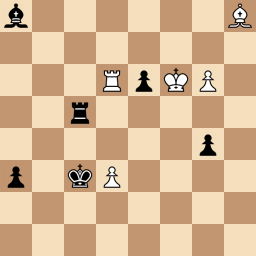
The 4th prize is a shame. Samilo should not send studies to Tarasiuk if he cares about the judge’s reputation. Obviously Vladislav is unable to evaluate his teacher’s studies objectively.
Good studies, good work of the judge.
Serhiy, what bothers you about the 4th prize?
Really? Do you really think it’s a good study? Good flow, sacrifices, logical try, no exchanges. Everything that you like. How could this be a bad study? Is that the question that bothers you? Or are you trying to babysit here?
Yes, that’s how it was.
I looked at the 4th prize and found it very successful.
Now I’m surprised that you find the study so bad.
Troitzky proclaimed that the IDEA makes the study. Nowdays composers don’t get it.
Samilo and co managed to implement a clear idea technically well. I see so many other boring move sequences with no idea.
Probably, one of the best back rank mates you’ve ever seen.
Only irony comes from you, no explanation. At the moment you think everything is shit.
If I want to ruin a study, I’ll send it to your tournament.
Martin, Didukh’s big problem is that by “disinfecting” study art, he has earned himself an allergy. Allergic to many composers. Among them are Samilo and myself…
Sergey’s allergy cannot be cured with a pill, it doesn’t happen like that. In the meantime, he sometimes faints from his stupidity…
Serhiy has also found my studies to be shit for some time now.
Secretly, I still value his opinion, so in defiance I will broadcast a study on the problem of Ukraine.
I did explain my point of view by the importance of the idea in studies. A primitive mate or a likewise primitive logical combination in the 4th prize is worth 1 point if its implementation is perfect. All your arguments concern the implementation of the “clear idea”. I agree, the implementation is good, the idea is bad.
Let me break Vladislav’s gossip by one recent fact:
Tarasiuk’s study won the Chess Study Art 2022 judged by Didukh.
No Sergey, you have an allergy to me too. You know this very well… Health to you and a peaceful sky to us.
Good scheme by Steffen with clear implementation. As he likes to say, 6. d4!! is for the guys at the club. I am asking myself whether one can make something more ambitious out of the scheme, but probably this version with the natural piece configuration and the near-symmetric material is just fine.
In the two main lines of my study, White sacrifices a rook to achieve a perpetual with the remaining rook, the king and the bishop. This theme holds the two lines together. The vivid play, the good economy and the surprising refutation of 6. Rd5? are on the plus side, but the drawing mechanisms themselves are non-original. I was lucky that the judge appreciated the development of the idea.
Good study by Serhiy: only at the end it is revealed why White had to push forward the d6-pawn. The zugzwang after Qf1 forces Black to play d5-d4, opening up the fifth rank for the queen and allowing a perpetual. Some by-play (typical of queen endings…) may annoy solvers.
The 4th prize… The idea is, of course, the most basic possible checkmate, but the realization is nice. I would not have given a prize, but I do not find it outrageous, especially taking into account the young age of the co-author and that this is a minor informal tournament.
Honorable mentions: Pasman’s first HM has some precise moves, but not enough appeal for me. But I like Gurgenidze’s second HM. The theme is more expressive than in his 1978 predecessor (which should be HvdH VI #43127, not #43124). I was asking myself which Prokes study anticipates the theme, since HvdH VI #68398 refers to a different work. Also the Avni/Minski 3rd HM has a spectactular finish. Both studies, however, may lack a bit of ambition for prize level, and they have minor drawbacks (the pawns standing around or being captured in the second HM, the spectator black queen in the third HM). 4th HM: If this were an ending in an OTB tournament, I would admire White’s technique, combining perfect technique with small tactical pointes, but for a study tournament, it feels a bit too much like technical conversion of a material advantage.
All in all: first to third prize are solid works and probably the best studies of the tournament. Or at least, it is not clear which of them should change ranks with another study in the award.
Jan, I tried building more ambitious stuff around this. For instance the White queen “orbiting the bishop”. But I failed. This is a version that is fun, but certainly not better (and 3. d4 is less effectful).
So ideally the queen should travel a8-g8-g2-a2. Good luck with that.
My main joy was in discovering the new tactic.
Well, the combination of 3. d4!! and 5. Qg8!! is impressive. The main problem is for me that there is a lot of non-thematic by-play in this version.