Judge Michael Pasman: “I received 17 studies from the director. There was no particular study that stood out above the others in this competition. Therefore, in another, very strong competition, none of these studies might not have won first prize, may be even second prize. But at the same time my approach is that prizes should be given out, including first prizes in every competition – just like in a sports competition. So I awarded 4 studies as prizes, the level difference between prize studies is not that big either”.
Magyar Sakkvilag 2022
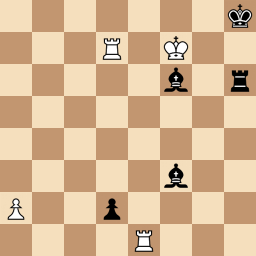
But tell me, were there any batteries?
The first two prizes with an interesting mechanism and good flow, but no real idea.
Garcia crap as always.
The most interesting study again by Serhiy.
But why is Serhiy’s study behind Minski’s (and in Finnish Ty behind Jan’s study)? 😊
The judge is funny. He talks about “good” studies and assumes that anyone who is not an idiot will recognize a “good” study immediately. Instead, the judge should explain what HE considers a good study to be.
I don’t think there should be prizes in every tournament.
Garcia does not judge a tournament without 10 prizes.
The first prize has a really interesting mechanism but it totally drowns in random batteries The questions, I want answered, are not answered (like why is 9. Rh8 a good move; what is wrong with 9. Rh8 Rb6+ ?). Also 8. a3? has a double refutation
In the end I just see just one long correct line and it even ends totally randomly in a position where there is still lot of play (14. Re1 Bg5+). This is the kind of study I definitely won’t be showing anyone at the club, since people will ask questions and I don’t have the answers.
Martin’s study may be good for solving but not for competition. Mitrofanov wants his move back.
The third/fourth prize by Krug/Garcia is just bad (as opposed to “good”).
Third/fourth prize by Didukh is fine, though of course hiding in the corner for this stalemate is not new.
Among the remaining studies I see reel ideas by Sprenger and Afek (2nd commendation). 1st hm is way too cramped for my liking.
Didukh’s study didn’t impress me. There is nothing unique in it, for which they give a prize…
Nowadays, it is not easy to surprise with a stalemate. The author could not do this either. In the introduction, the departure of two pawns is unpleasant, the capture of the a2-pawn looks especially ugly … But most importantly, what did Sergey want to show in the study? What is his idea? In a well-known stalemate or in the second variation of an unattractive positional draw? Or that “the snake is crawls back” or “the snake is crawls to the left”?!
Now, if the author, for example, in the second variant could show a stalemate in another corner of the board, this would be original and really become an interesting DEVELOPMENT of the well-known stalemate idea.
Vladislav, it’s not a problem for a good expert in studies to see that the fundamental idea of this study is unpinning Na2. This idea binds together all the lines and tries (explained in a post below). In the intro Black pins Na2. But idiots will see only captures.
Serhiy, a good expert, could draw the white knight to a2 without forcibly capturing black’s strong passed pawn. Is this your level? Not better without the first three moves? Only idiots rush to publish their studies, not paying due attention to finding a successful introductory game…
And I rate your non-original study at 1,5 points.
I saw your ratings. They are very eloquent. Something is wrong with your head.
Indeed, your score of 1 point is very eloquent. Something is wrong with your head.
Good to hear that we have a lively discussion again!
I also think there is no idea in the first prize. What is more, the authors do not understand either what is going on. For example, the real question on move 5 is why Rb8! is unique and why one cannot “gain more space” with 5. Ra8. The engine tells me that Black has the beautiful and even somewhat thematic win 5… Rb6+ 6. Ke8+ Kg8 7. Rd4 Bf3 8. Rc8 Rb7 and Bh5# cannot be parried. Same for 8. Rb4? Rb6+ 9. Ke7 Bd6+!. The authors just randomly throw lines at the reader, without any idea that explains the white play.
My own study is a similar mix of strategic and tactical play (improve position, then strike etc.), but I think it is more unified since all relevant lines have the long diagonal as protagonist. Such a unified theme is absent from the first prize. Something interesting can probably done with that theme, but the authors settled for an unsatisfactory implementation.
As Steffen noted, the Mitrofanov move devalues the originality of the second prize. Still, I find it pleasant that Martin has added the stalemate counterplay, a pointed finish and an excellent key. Solid HM level for me.
Third/fourth prize by Krug, Garcia, well I guess they will be happy, nice for them, but not nice for the journal. MSV is read by many chessplayers and we should care about what we advertise to them as good studies.
Serhiy’s study attracted my interest as a practical chess player because it is instructive to see when there is a positional draw and when there is not. But from an aesthetic point of view, it does not really convince me. The main theme should be the positional draw with the “exchange of pins” (a-file, second rank). The pleasant stalemate line, which Serhiy has raised to a mainline, is relevant but not central. And I doubt that the various lines with the positional draws are sufficiently clear and pointed to make the study memorable, and to assign it a prize. As to the introduction, the snake-crawling is a known theme from other works and here I do not see the value it adds. Of course, the study is interesting, but more in the scientific way.
Ah, I think the Avni/Afek study in Zhukov style, first HM, is quite good after all. It has a fresh and original idea. Of course, the position is crammed and I would not choose to compose that way, but it is one of the few studies where you may want to use the label “memorable”. Good moves make good studies. 😉
Zhukov style would be removing 6 pawns.
Zhukov’s style is to make 100 versions of the famous Zakhodyakin’s combination:
https://eg.org.ua/chessgame/zakhodyaking-3041-10a2a4/
In Serhiy’s study, 4.Kh1!! very surprising. The play before and after is instructive. It is never a disadvantage if a study ends with a stalemate, even if that stalemate is known. For me it’s worth a prize overall (no matter which main you prefer).
Martin, the idea of moving the king into a corner with a final stalemate is well known. As an idea, it is no longer so interesting and not original. It is important. Do you remember my study from MT Dvoretsky and criticism of Didukh? More without comment…
It’s good to see that you started evaluating studies based on their ideas, now the next step is to train your mind to see all the ideas inside the content and feel their real power.
Kh1! is not only because of stalemate. There are several ideas in the position and it also depends on the right move order.
The judge used his ChessPM Search Engine to find predecessors, so I think he knows that my study is based on this incorrect study by Kasparyan and his Ukrainian co-authors:
https://eg.org.ua/chessgame/kasparyang-bondarenkof-nn-0441-11c2h8-mc-u3/
The new study combines the stalemate line that cooked the old study, the authors’ main line with the bishop’s retreat and the positional draw with the pinned bishop. When Na2 gets pinned White has two possible ways to escape: positional draw and stalemate. It’s so easy to miss the stalemate defence when you wait for a chance to attack or pin the bishop. Kasparyan didn’t see it. So, it’s a main line too.
Thank you for pointing out the predecessor, Serhiy. I knew the manoeuvre of the bishop crawling back, but I forgot where I had seen it.
Clearly, the study is progress with respect to the cooked predecessor. Still, it appeals to me more from a scientific viewpoint than purely aesthetically. Moreover, people may claim (as Vladislav did, in fact) that you essentially did a successful correction.
I read here different opinions from different composers about which study is better and which study is less good.
I am completely satisfied with my report and if I was doing it again , after all comments I have read here, I would do exactly the same.
As I said sometimes there are small differences between studies and one study could be little forwarded by other judges and other little downgraded. It is acceptable.
I agree that there can be also other opinions about specific study. That’s fine as long as it’s an honest assessment and not assessment because of specific taste of the judge.
You can look also on my report. My full award is here : http://www.chesspm.com/books/pdfawards/MSV2022.pdf
That is in contrast to uncomplete award published in Arves, because the director declined to publish my final award, which I send him as a correction immediately. I don’t know why.
In this link you can see all the studies, including not awarded studies.
http://www.chesspm.com/ShowPuzzles.aspx?glist=MSV2022&sq=5
If somebody thinks that some good study was not awarded.
First of all when we speak generally about study’s idea. We have to look not only on the idea but also on the implementation of the idea. Sometimes study can be good even with a simple idea and a very good implementation, But a good idea and poor implementation cannot make all study good.
About some studies which were discussed here.
Hlinka-Kekely (1st prize). No idea?? Of course the idea is many batteries.
One can like more and another less the implementation of the idea. It is not ideal, but I think it is not bad implementation.
Minski (2nd prize) – the idea , it is true is not good enough. Just many sacrifices and good solving study.But nice implementation, nice 1.Qf2!! move.
Krug-Garcia (3rd-4t HM) : I wrote in the award what, in my opinion can make some little improvement to the study. As I wrote in the award composers should add line 9…Qxf6, as second main, because its connection to main line. In both lines we received different final (mate or winning the queen) after new queen promotion of different pawns. In my opinion it should add quality to a study.
Didukh (3rd-4t HM) : – I see some composers like this study , other say it is very bad.
I look on this study differently. I didn’t know about Kasparyan study, my search engine didn’t find it, because the change of colors and also different result (draw/win). But for the same reasons I’m not sure it should affect the rating even if I knew it. First of all , in my opinion the introduction is Ok – without it knight would be captured unmoved and also it shows how the knight is going to be binded – which in my opinion should be the main idea of the study. I think that the author didn’t show the study correctly and missed the main idea that could be of the study. So I corrected it (see my comments in the award). Instead of making mate as main A line, better, in my opinion, is is develop the second line and create a main idea of binding back the black bishop. The fact that this idea exists added more points in my estimation,But if the author had initially presented in this way, I might have given it even higher rating.
Here is pgn which in my opinion is preferable and I think that it is better for Serhiy to use this move order and 12. Rc2+ Kd8 13. Kg2! d6 14. b5 addition.
Avni-Afek (1st HM) – I agree that it is good study, on the same level as other prize studies of the tournament. But also1st HM is ok.
Sprenger (2nd-3d HM) – yes, the study has idea, the idea is good, but I less like the implementation of the idea. It is not enough that a study has idea – first of all we have to examine how is the idea – very good – good or even just bad. But totally the study is good,2-nd 3-rd HM together with another good study by Arestov (with unexpected, surprising zugzwang positions and nice maneuvers with white king) , is completely Ok.
Martin claims that in my opinion studies of the tournament are not at very high level and he wants to know how I see a high level. So I’ll give example – just one study of many excellent studies – study I have seen only today. 1st Prize Selivanov-55 event, finished few months ago (you can see it here) co-production by Arestov and Pervakov – excellent study. Good idea , very good implementation with pretty multiple logical tries, Interesting position and very nice and attractive play. Judge : Selivanov. Very good study and very good choice. After more proper look I saw a small drawback : Bxe6 exchange., so it could be implemented even little better I believe. But this is just one example if you want I may find many examples of how I see excellent study.
Well, Michael, I don’t have the power to persuade you that the idea sets the level of a study while its implementation only shows if the idea receives all the points it is worth or not. Implementation doesn’t add extra points because it goes together with the idea. You can’t separate the value of the idea from its implementation. But you did because you wrote that some studies received their points for ideas, others for implementation.
When we agree that the idea sets the level we are able to see at once which studies are good or could be good. See, for example, Nielsen’s comment above – his first intention was to idetify studies with ideas. That’s how good judges build their evaluation. The situation “I awarded 12 studies of the same quality” decribes the judge’s level, not studies.
Back to my study. If you add Rc2+ Kd8 in the end – it’s not a positional draw anymore, it’s a draw by force: b5-b6-b7.
I think you don’t understand me. I said 4 prizes are not big difference in quality. This is as I see. My order of them is a order that I see most correct, in other case I should award all prizes as 1st-4th Prize. I said that other judge could put 1st HM as prize – it could be accepted. Or other judge could change some of prizes order – it could be accepted (although I don’t think so). Other HMs are different level. And of course commendations are lowest level here even with big difference from 3rd HM. If Nielsen points commendation study and says it has good idea – but I see the idea is Ok, not something special and the implementation is not good – how this study can be awarded higher even as a Prize? I’ll never do that.
I can squeeze my previous post to one phrase:
A study with the idea is always better than a study without it.
The 1st prize and 3rd/4th prize by KruGa don’t have a clear idea, they are a mess of moves. That’s why a commended study by Afek is better than these two prizes.
I know that Afek has very good ideas and I appreciate that you also think this way. I have learned a lot from Afek and his studies during my career. Not only last years even when I was just chess player. In my opinion this specific study was not enough to be Prize. But ok, we can also disagree in that
And about your study – you don’t agree that line B was better main line with black bishop binding ? And you are right that after 14.b5 it is no more positional draw, so you could write : 12. Rc2+ Positional draw, and on : 12…Kd8 13. Kg2! d6 14. b5 =
For me it’s a study with two main lines: main A = main B. I can write positional draw line as main A and stalemate line as main B. And I see no problem when the judge presents the solution in his award the way he thinks is best.
And don’t you think that emphasizing the pinning and counterpinning improves your study somewhat? I think many judges wouldn’t make an effort to pay attentiion on it. Because most see only stalemate which is less interesting.
Positional draw with counterpin is also a known idea:
https://eg.org.ua/chessgame/birnovz-0434-11a6a1/
https://eg.org.ua/chessgame/kasparyang-0431-32e1g8/
The line with a model stalemate develops these studies.