Judge Steffen Nielsen: “11 studies took part in the 2022 informal study tournament of the Macedonian Problemist, the first of its kind. As the tournament wasn’t announced until well into 2022, the number of entries was satisfactory and so was the level. The two top studies were very close in quality. In the end I gave first prize to the most ambitious idea rather than to the amazing flow of the other candidate”.
The Macedonian Problemist 2022
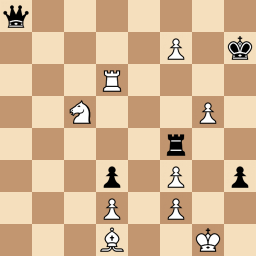
It’s a pleasant surprise that Steffen preferred my study to an elegant performance of the knights on the mine field in the 2nd prize which I like very much. I thought he would dislike more the capture of the dead rook in the original version. I was satisfied to show the idea with two major white pieces only. Adding the third white piece seemed to me a bigger crime than some artistic drawbacks. The new version proves me wrong.
Excellent synthesis of ambitious idea, fluent play and attractive final in this version.
A strong message about “chocolate” studies: “The study by Minski/Avni, though of course skillfully crafted, too much resembles previous similar tactics of stalemate avoidance and unguarded guards”.
I worked intensively on this study and am very satisfied with the result. But the judge doesn’t have to like that.
I don’t know what chocolate study is, but coming from the blogger it must have a negative meaning.
like Martin, I am very satisfied from the joint study. On the positive side – if the judge have granted us a commendation, it would have been a greater insult from omitting us completely.
The judge likes your study because he didn’t award it a commendation. That’s too subtle to be true.
I think the judge liked your skill to pack a hundred sacrifices in one study but he was irritated you couldn’t stop sacrificing in the intro and even added more pieces just to be sacrificed. Everybody likes sacrifices and chocolate. But having them on breakfast, dinner and supper is not good for study and body.
Why did you delete the other post where you added some studies for comparison? I thought it was useful. Moreover, I agree with your view there are things to like in the Avni/Minski study. The threat of stalemate forces White to give a bishop and to open the cage for the black king, but the queen is dominated and there is a new threat (fork).
In general, I agree with your point about introductory sacrifices, and certainly, some of Martin’s studies can be criticized for excessive use of them. But in this concrete case, I think that Ng6+ is actually useful because it contributes to constructing the cage for the black king.
These studies don’t really anticipate the AA/MM chocolate which main virtue is the final domination, so I deleted them. You found a great way to make this domination larger with another fork after Qd3+ f3.
The fourth white piece for the sake of fxg6 is kindergarten level. I don’t like black bishops either. They are guests in this study. I can stand one bishop but two is too many.
Ah, by the way, too bad that the main line does not allow for Kg3 Qd3+ f3 g5 Rh8+ Kg6 Ne5+ 1-0. That would have been a nice echo fork. Probably Amatzia and Martin saw that option but found it too difficult to implement. I have looked a little bit and have no clear idea either (some challenges are the f3/Kh2 dual, finding the right square for the black queen, etc.). But perhaps Martin can have another go. 🙂
Ph2 will fix the dual.
I saw Ph2, too, and perhaps the technical pawn is no big deal. But I found no way of making the scheme work because the bQ can give check in various places. Again, I looked just briefly, so perhaps somebody who has good technique and a free afternoon can fix it. 🙂
Good technique and the whole afternoon are not needed to make it work. It’s a pity the authors prefer their chocolate version and are not going to consider your suggestion.
Show your version, you champion! I’m curious. I also like unique delicacies 🙂
Good job, Serhiy! Nb8 to free c6 for the queen is really nice.
Probably we can add some chocolate, too (provided that 1… Kd5 wins indeed, but I am rather optimistic on this point). I am not sure whether you will like it, but I guess the authors will and an introductory sacrifice seems like a fair price for hunting the king from the open space into the cage. This version also highlights the great job of the white knight.
Serhiy adds a technical pawn on h2 to have a second fork on e5. The question I ask myself is whether this is a full-fledged Echo variant or too primitive and not worth it. This is certainly a matter of taste. It is completely clear to me that Serhiy has the technique to find a good introduction with sacrifices in his version. Jan’s additional sacrifice on c3 is certainly possible, but doesn’t it contradict Serhiy’s “ban” on sacrifices in the introduction?
In principle, one can expect that more and more experts will develop new ideas from a scheme. If it were my study, I might have suggested a co-production, but the basic scheme belongs to Amatzia.
I agree with you that personal taste and aesthetic ideals matter for judging the different versions.
That said, I do think that a single technical pawn does not matter much in a middlegame scheme if in exchange, the domination can be extended to a different square and a second line emerges. Whether you call this echo or not, to my eyes it looks much nicer than simply g5 Nxg5+, capturing the queen.
Regarding my introduction, I think that the Bc3+ sacrifice is organically integrated into the content of the study. First, it is motivated by the idea of forking king and queen (Qxc3 Ne4+). This occurs later in the study, too. Second, it is instrumental for constructing the cage, for preparing Nc4 and Nd6+ etc. Third, it allows for the knight route e4-d2-c4-d6-f7-g5-e4, returning to the initial square. As I wrote above, the knight is the hero of the study (domination + forks) and the new introduction highlights this fact.
Here there are some examples where the sacrifice is less functional with respect to the main idea:
https://eg.org.ua/chessgame/sprengerj-minskim-3810-32h3f5/
(I do not like starting with queen promotion, but I understand the critique of 1. Bd3+ as superfluous)
https://eg.org.ua/chessgame/sprengerj-3213-31a8b6/ (better to find a version without the Be2 sacrifice)
https://eg.org.ua/chessgame/horneckers-minskim-0256-61a1c2/ (I do not see the added value of Rc1+ and I do not like that both rooks are attacked in the initial position)
Finally, something personal: I prefer a roughly balanced material distribution in the initial position, if possible. In Serhiy’s version, White is hopelessly behind whereas here, the two bishops and the initiative compensate for the queen. So we start with roughly balanced material, both sides sacrifice two pieces and we end with roughly balanced material, too. By the way, the final slightly recalls your 2019 Moscow study with Hornecker and Reddmann. 🙂
https://eg.org.ua/chessgame/horneckers-minskim-nn-0401-11b4c7-mc/
For me the central idea is domination and to dominate the queen that can escape the first fork with a check is certainly worth the Ph2.
Of course, I think that another sacrifice in the intro is a crime. Jan never follows my advice. He puts too much weight to superfluous things and in the end he always succeeds to convince himself that they are important. Introduction is not important by default, its weight in the study is minimal.
These both versions are based on Jan’s suggestion. He may be your co-author, not me.
No, the fork is just a little final joke. It’s actually about mate and avoidance of stalemate. That’s why I included the logical elimination of the black Bishop e2 in the introduction. I think that was in keeping with Amatzia’s original idea.
Studies typically tell stories. An introduction needs to be evaluated with respect to whether it contributes to the story, or whether it is a disconnected prologue. Ideally, it anticipates or underlines some of the main motives and helps to build up the tension.
Fair enough if you prefer the economic version with 1. Nd6+ (this is also an excellent version for solving), but I think it is absurd to call the three extra moves with Bc3+ a “crime”. The route of the knight makes a strong impression and the fork motives are coherent with the rest of the story.
Moreover, in the version with 1. Nd6+, all white moves are completely forced. Even 9. Be4!! has no promising alternatives.
The route of the knigth is a superfluous accidental idea. It makes impression only when position doesn’t change much from the start till finish of the route. All three forks are in the economic version too. The fourth major white piece turns an endgame into a middlgame, so it’s a crime to add this piece for an intro sacrifice and secondary subtleties. The forced play will not be less forced when you add an analytical intro. As a result, you’ll have a bad intro and a forced main play. 🙂
Point taken. I just note (regarding “all three forks”) that there is 1. Nd2+ Kd6 2. Nc4+, too.
Also, I do not know why you call the intro analytic. White has multiple clear wins after 1… Kf4 and 1… Kd4, all based on obvious moves, while after 1… Kd5 the endgame is technically won. This is not at all a plausible candidate for defense. Probably I should win this against optimal Black play, but if I prove to be unable, Magnus will do it for me. 🙂
Indeed. But of course these are random forks in the intro and the final forks make domination. Ok, the intro is not analytic, it’s just less forced.
In my view, this is clearly a better version than the original.
1) Two echoes
2) The black king is chased into the corner area
3) More economical (with one pawn more but also with one piece less). 3 vs 3 pieces still feels like an endgame.
4) With better flow, and probably easier to solve
5) Longer solution (and the Qd3+ variation is much nicer than the original finish with g5)
6) A critical move by the white rook Re8xa8 (although black’s Ra8 has a double purpose)
7) Fewer sacrifices 😀 (Less is better. Having more sacs can diminish the impact of the main sacrifice. But of course, your mileage may vary.)
What one could miss from the original version is the Queen sacrifice on a8
And two black bishops-obstacles to the main Black plan Qa8+! are missing. They are eliminated by I type foreplans.
I would like to thank Serhiy for presenting our study here, even though it is not included in the award.
I find the whole discussion about our study absurd and amusing. It’s good in all parts. Thanks to Amatzia for the great scheme! I would build it again the same way, even if Nielsen, Didukh and Sprenger and all their names have something to complain about here. There is Amatzia, with whom I will develop more such great studies. I still know where is up and down.