Judge Michal Hlinka: “50 studies were sent to the competition. I divided the tournament into two sections A) studies up to 10 figures and B) other studies. I appreciated original concepts”.
Michal Hlinka-70
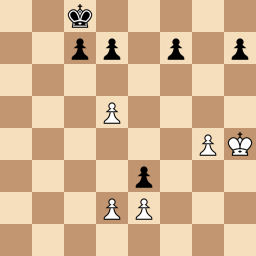
Judge Michal Hlinka: “50 studies were sent to the competition. I divided the tournament into two sections A) studies up to 10 figures and B) other studies. I appreciated original concepts”.
This famous study (even Tarasiuk knows it) is much better than 1/3.p by Pasman.
https://eg.org.ua/chessgame/khortovv-ryabininn-0706-30c6h5/
Isn’t this serious anticipation?
No, if the main idea is 15.Qxd5.
But if the main idea is to incarcerate the rook and g5! the answer to your funny question is yes.
My question would have been funny if there was only one possible answer 🙂
So, if you were the judge, would you have pointed this study as anticipated or not?
An example that will hopefully clarify my question.
The judge of FRME 2022 considered this study anticipated because the ending is the same as Pogosyants, 1976. But the ending was an accidental found. The main idea is Bf3+/Be4.
Would you have claimed anticipation, here?
Of course other composers/judges can answer too!
Be4 is a new idea, so the study has the right to exist. Its value would be more if the positional draw too would be your invention.
It is incorrect to call this anticipation. Everybody knows this final, it was in several studies. Even the judge points on 2 studies with the same final, one of them is very simple study of Simkhovich,1924.
Only same final position is never anticipation. The question is what leads to this position. Ryabinin’s study is not bad, but I like my study with queen maneuvers and at the end queen sacrifice more. But in this case it may be question of taste
Your queen maneuvres are just a bunch of checks answered by king moves. There is nothing artistic there. The study isn’t worth anything without that well-known final. The small novelty is only the sacrifice of the queen instead of a rook at the end. The study is not fully anticipated, it is publishable but of no real value.
On the other hand, your pawn study with a similarly anticipated ending has more added content, and it is a good study.
To find move after move the correct square for check of several options is not “bunch of checks”. You also have a limited understanding of what is “anticipation”.
The judge wrote, “I appreciated original concepts.”
What is so original in this first-prize study which looks almost fully anticipated?
Putting a different intro to an artistic final usually doesn’t lead to an original creation. We call that a “version”.
As I said, you have very limited understanding.
Read what writes a judge about this study, with much better understanding “Although the idea here is not new, e.g. Simkhovich
1924 (Kd1-Kg8), or V. Kaljagin 1991 (Kh2-Kg8), however
none of the previous authors have done so well
and elegantly develop the game!”
That just proves that the judge was not aware of the most serious anticipation which annulates your study.
I guess you still pretend that “none of the previous authors have done so well
and elegantly develop the game!”
Oh, now I see that Kaljagin (1991) already used a Queen. Even the capture of the bishop was already there…
My top-3 are:
I agree on Timman and Bazlov/Neishtadt. I find Arestov’s study a bit too linear. I also like Pervakov’s scheme with the thematic try. Pity the introduction is that rough, but probably hard to avoid.
After the winner in the Moscow ty 2023 all these ugly studies with 3 knights and zz should go to the waste bin.
Everyone knows that receiving an hm is more prestigious than a shared first prize.
In particular when Hlinka judges. I really appreciate his column in CZ Sach and the way he promotes chess studies, but honestly I have never understood his criteria.
This funny game with hanging queens
https://www.youtube.com/watch?v=0yopom_euo8
is anticipated/inspired by Steffen’s study
https://eg.org.ua/chessgame/slumstrup-nielsens-4440-21h1e2/