In Pasman and Tkachenko’s studies, which I find among the better ones, I would have omitted the first and second pair of moves. The position is more natural and the additional moves do not add thematic content. Perhaps even leave out the third pair in Pasman’s study so that you get a miniature. On the other hand, the f8=N mechanism in Pasman’s study looks only mildly original, so perhaps an introductory sacrifice with thematic try is needed to add some content.
Hlinka/Kekely/Arestov managed to construct their pin stalemates cleanly, but the preceding play has a lot of strange analytic lines. I am even unsure that it is sound. The line 5… Rb7 … 9. Kd4 can be continued with 9… Rd8+ 10. Nd5+ Kg2 11. e7 Rc8 12. Nc7 Bb7 and now transition into the lost endgame BN vs RB with opposite-color bishops looks inevitable.
Minski & Nielsen have a cool idea, but I am close to throwing Gurvich’s book at them (economy of material).
What the other prizes are for I cannot even imagine. But I like the first HM by Arestov and Hlinka. 6. Rf6!! (delaying the Siegfried rook action) is for the books and also the rest of the play is instructive.
Polasek participated with analyzed positions. Gonzalez sent in another database rubbish. Obviously, computer and databases are not enough to become a composer.
Everybody knows that Luis Gonzalez is a syzygy tablebase miner and he took this position from there in one click – it is the longest win with this material. Then he added a pawn to hide his crime. Idiot at work.
I am asking myself what kind of pleasure Gonzalez derives from making a tablebase printout and sending it to a composition tournament. Probably he is a sort of troll and actually enjoys the shitstorm on the blog. 🙂
Fun fact: I once sent a study to a tournament where Gonzalez was the judge. I sent it there for that reason, because Gonzalez loves repeated manoeuvres, and my study was based on that (but 20 pieces on the board, and human idea, surely not tablebase mining). Not even a commendation!
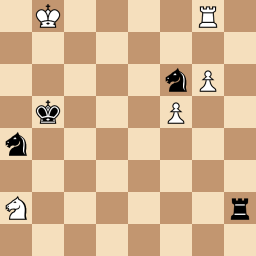
Чехословацкий шах поставил этюду мат.
A lot of prizes, but none of them exciting.
In Pasman and Tkachenko’s studies, which I find among the better ones, I would have omitted the first and second pair of moves. The position is more natural and the additional moves do not add thematic content. Perhaps even leave out the third pair in Pasman’s study so that you get a miniature. On the other hand, the f8=N mechanism in Pasman’s study looks only mildly original, so perhaps an introductory sacrifice with thematic try is needed to add some content.
Hlinka/Kekely/Arestov managed to construct their pin stalemates cleanly, but the preceding play has a lot of strange analytic lines. I am even unsure that it is sound. The line 5… Rb7 … 9. Kd4 can be continued with 9… Rd8+ 10. Nd5+ Kg2 11. e7 Rc8 12. Nc7 Bb7 and now transition into the lost endgame BN vs RB with opposite-color bishops looks inevitable.
Minski & Nielsen have a cool idea, but I am close to throwing Gurvich’s book at them (economy of material).
What the other prizes are for I cannot even imagine. But I like the first HM by Arestov and Hlinka. 6. Rf6!! (delaying the Siegfried rook action) is for the books and also the rest of the play is instructive.
Five studies have bad initial positions with at least 5 major pieces and only one pawn or no pawns at all.
Positional draw with a promoted N vs RN is not new. Pogosyants’s promoted knight worked even more.
https://eg.org.ua/chessgame/pogosyantse-0304-20c7g6/
Polasek participated with analyzed positions. Gonzalez sent in another database rubbish. Obviously, computer and databases are not enough to become a composer.
Bullshit.
Everybody knows that Luis Gonzalez is a syzygy tablebase miner and he took this position from there in one click – it is the longest win with this material. Then he added a pawn to hide his crime. Idiot at work.
Maybe the following is interesting for you:
https://endgame-studies.jimdofree.com/articles/dtz-material/
If you don’t want to read everything, I recommend
https://endgame-studies.jimdofree.com/articles/dtz-material/is-it-really-that-simple/
and
https://endgame-studies.jimdofree.com/articles/dtz-material/it-is-really-that-simple-i-viii/
The author should consider stop composing.
I am asking myself what kind of pleasure Gonzalez derives from making a tablebase printout and sending it to a composition tournament. Probably he is a sort of troll and actually enjoys the shitstorm on the blog. 🙂
Fun fact: I once sent a study to a tournament where Gonzalez was the judge. I sent it there for that reason, because Gonzalez loves repeated manoeuvres, and my study was based on that (but 20 pieces on the board, and human idea, surely not tablebase mining). Not even a commendation!
It’s not a fact that Gonzalez loves repeated manoeuvres. He knows where to take them.
Now I know!
Well, Rusinek could award the 1st prize to this waste-your-time-on-duals monster. But to be certain, you should put your name on top of the diagram.
I hope Polasek hasn’t improved this study yet. Or we may see a patriotic judge Nosek give this bullshit a prize in the final award.
Let’s call him Spanish Printer.