Судья В.Тарасюк: “На конкурс памяти известного украинского харьковского этюдиста, четырехкратного чемпиона Украины Станислава Белоконя поступило 44 этюда от 28 авторов из 16 стран. При присуждении я оценивал, прежде всего, новизну игры, учитывал единство формы и содержания, тонкости в решении. Некоторые участники прислали на конкурс несколько своих этюдов. Судья выбрал и отметил лучший из них”.
Станислав Белоконь-85
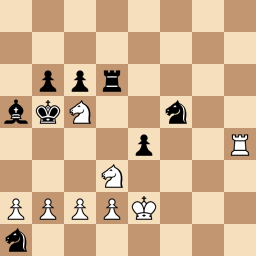
Thomas Niessen told on his webpage how he composed his study. My study didn’t require so much effort. I composed the position before 4.b3+ in my head. Then I set it up in Chessbase on my computer to see that the lines were correct and added 3 first moves. The idea came to me from the name Belokon which means a white knight/horse. That’s why I decided to do something with a white knight that hasn’t been shown before.
I like the 1st Prize study!
Probably you’ve also tried to have the bishop on h4 but that didn’t work.
With Bh4 I could bring Nc5 and Rd6 but bringing thematic pieces Kd1 and Pa4 was too difficult for me. Besides, this needed two extra pawns Pc5 and Pa5. So, I quickly settled for Ba5, also because the bishop guards e1 only after 7.d3+ which adds to the surprise.
Both your study and Costeff’s 2014 study are a bit like modern paintings. As a spectator, you are always asking yourself whether it is actually a masterpiece or for the trash bin. Like the famous museum cleaner who asked “Ist das Kunst oder kann das weg?”.
If I not mistaken Serhiy was the judge of Costeff’s study from 2014 and even mentioned Picasso in the award.
Yes, Gady composed a great study. I still like it in 2024.
Of course, it’s not funny at all to see that each of 28 participants has his study in the award and only one entry could be awarded (this wasn’t written in the announcement). A study should merit its distinction. To have junk studies in the award is not good for the art.
Wild stuff.
Serhiy broke all the rules and succeeded
Jan S. tried to add as many heavy pieces as possible and succeeded
Michael put four a-pawns on the board to hide the fact the the main action was on the h-file and suceeded.
Jan T. chose the same mating pattern and sac on g3 in another childish super-GM study and succeeded
I made a study for those who can only afford half a board. The queenside plays no role in any line or sideline and I am guessing the study would still be correct on half a board.
But the biggest performance was Martin’s. He made a normal study and suceeded!
I have an old plastic board which once fell apart. Good to know that there is still some use for it.
On the award, yes, a lot of wild stuff. The bizarre beat the conventional. Martin called my study an “Elefantenballett” and did not really know what else to say about it. (This will be rendered wrongly in Russian since in German, the elephant is no piece; instead Martin referred to the heavy setting.) Therefore I thought that the miniature which I sent would be more successful, but I am happy that the judge appreciated my attempt to do show well-known tactical motifs in a unusual material setting.
A study with 8 queens and a natural initial position:
https://eg.org.ua/chessgame/razumenkov-4000-36g2h4/
The same logic as in the 3rd prize with N instead of Q and without annoying tactical clatter in the intro.
https://eg.org.ua/chessgame/rinckh-0004-21f6d5/
The try shows that the piece is an obstacle to stalemate. The second obstacle makes White choose the right square for sacrifice.
Of course, I used CQL to search for other studies with an active or passive incarceration of white knight in the center (not on the edge of the board). Zero matches.
There’s a study with incarceration of Nc1 (4 blocks needed). I added a logical combination to make it “modern”.
Incarceration of Bishop in the center has been shown before. Here’s my correction of the best study with this idea.