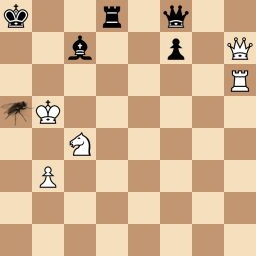
Я уже публиковал небольшую заметку про известный этюд Куббеля “Как Куббель открыл шашечную тему“. Когда А. Ставриецкий ее прочитал, он, в очередной раз, изучил начальную позицию этюда и увидел лишний материал (“Загадочная черная пешка” Задачи и Этюды №68 2016). Но поскольку до сих пор даже гроссмейстеры композиции продолжают печатать этюд с ненужной пешкой («Шахматный этюд как искусство» 2023, Польский конкурс 2023), то расскажу еще одну историю про этот этюд.
Мухе нравилось в квартире Куббеля. Пока хозяин, как вкопанный, сидел за шахматной доской, она могла без страха и риска смаковать всем, что осталось после обеда на столе. Муха позволяла себе даже спокойно вздремнуть часок прямо в сахарнице, когда видела, что ее сожитель очень увлечен черно-белыми деревяшками. В состоянии творческого вдохновения глаза у него блестели, он потирал руки, выстукивал пальцами разные мелодии и что-то мычал в нос. Под такую колыбельную муха быстро засыпала.
В тот трагический день ее разбудил грохот копыт. Композитор, согнувшись так, чтобы походить на шахматного коня, прыгал по комнате: один раз влево, два раза вправо. Потом, выпрямившись, он изображал ферзя и летел в угол, где снова перевоплощался в коня: прыжок влево и два прыжка вправо. Напрыгавшись, он уселся за стол рисовать шахматную диаграмму. Диаграмма понравилась мухе, и красота ее погубила. Куббель прихлопнул муху в тот момент, когда она села на поле а5.
В редакции газеты, куда композитор послал свой этюд, пятно на диаграмме приняли за черную пешку. С тех пор сто лет муха притворялась пешкой, заставляя всех сомневаться в технике Куббеля.
Друзья, не ходите под мухой! Пешка ненастоящая!
Вот три версии этого этюда: 1) оригинал без мухи, 2) версия А.Ставриецкого с белым ферзем в четырех углах и 3) моя с играющим черным ферзем.
But it’s acceptable for Marek Kwiatkowski to capture 3 major white pieces that didn’t make a single move. However, he knows what is unacceptable for Kubbel.
There are artistic principles. Move pieces, don’t use extra pieces etc.
Interesting fact. Kubbel has 50 studies in the database with a white pawn on the 7th rank in the initial positions. And Marek Kwiatkowski has only 12 studies (2 of them are versions). An extraodinary artist and study expert! 🙂
In other studies by Kubbel the black queen often doesn’t move. So, either his technique wasn’t good enough or his conception of beauty was too primitive and he didn’t care about black pieces.
The black queen has to move in the next studies because she is an important piece in the ideas expressed.
1. The checkers theme with two black queens captured.
2. The famous study that uses Qe7 to defend Ne3 and mate the black king. This study needs a quiet move 1.e7! that decoys the queen.
This night I’ve been solving studies with bishops from Steffen’s “Endgame Labyrinths” and ran into no.201 by trio YB + KS + VT that was initially awarded 5th prize in the Razumenko 2020 MT but disqualified in the final award. I knew the study was anticipated but couldn’t remember who showed this idea before. So, I marked/liked Ornstein’s study in order not to forget it again.
The line where Bishop and King swap functions is important, indeed. Now this version is in the database instead of Ornstein’s version.
I have no idea why you call black pawns “stinking insects”.
Well done. Good studies need the best versions.
https://eg.org.ua/chessgame/van-der-heijdenh-0000-21h2f1-v/
Always brave to have a go at improving the classics. From a solving/promotion perspective Harold’s is still the best (published in a regular newspaper as well).
Having pawns on e2 and g2 means the bishop-was captured on f1. I know Martin, for instance, is not bothered by this stuff, but I suggest putting the pawn on g3. Makes it slightly more natural to me.
I am not bothered by the e2-g2 pair either. Excelsior of the g-pawn and its switchback Qg2# is not a big deal but still it is nice and I’d prefer to keep it. Another little detail that I like in Marek’s version is sacrifice of the g-pawn after 2…Kd3 3.g5!
Database is a different site, you have to register there too.
The dislike is from a stupid person who doesn’t know how websites work.